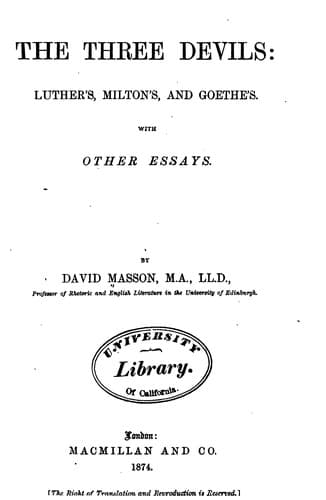
The Three Devils: Luther's, Milton's, and Goethe's; With Other EssaysMasson, David
History
The Three Devils: Luther's, Milton's, and Goethe's; With Other Essays
Masson, David
Devil in literature; Literature -- History and criticism
those peculiarities which shock people in his writings. His principle
being to view things as they are, with no regard to the accumulated cant
of orators and poets, he naturally prosecuted his investigations into
those classes of facts which orators and poets have omitted as unsuitable
for their purposes. If they had viewed men as Angels, he would view them
as Yahoos. If they had placed the springs of action among the fine
phrases and the sublimities, he would trace them down into their secret
connections with the bestial and the obscene. Hence, as much as for any of
those physiological reasons which some of his biographers assign for it,
his undisguised delight in filth. And hence, also, probably--since among
the forms of cant he included the traditional manner of speaking of women
in their relations to men--his studious contempt, whether in writing for
men or for women, of all the accustomed decencies. It was not only the
more obvious forms of cant, however, that Swift had in aversion. Even to
that minor form of cant which consists in the "trite" he gave no quarter.
Whatever was habitually said by the majority of people seemed to him, for
that very reason, not worthy of being said at all, much less put into
print. A considerable portion of his writings, as, for example, his
_Tritical Essay on the Faculties of the Mind_, and his _Art of Polite
Conversation_--in the one of which he strings together a series of the
most threadbare maxims and quotations to be found in books, offering the
compilation as a gravely original disquisition, while in the other he
imitates the insipidity of ordinary table-talk in society--may be regarded
as showing a systematic determination on his part to turn the trite into
ridicule. Hence, in his own writings, though he refrains from the
profound, he never falls into the commonplace. Apart from Swift's other
views, there are to be found scattered through his writings not a few
distinct propositions of an innovative character respecting our social
arrangements. We have seen his doctrine as to the education of women; and
we may mention, as another instance of the same kind, his denunciation of
the system of standing armies as incompatible with freedom. Curiously
enough, also, it was Swift's belief that, Yahoos though we are, the world
is always in the right.
HOW LITERATURE MAY ILLUSTRATE HISTORY.
HOW LITERATURE MAY ILLUSTRATE HISTORY.[8]
Public-domain text, read in full here on John Shaqi.
Reviews
Reviews
No reviews yet
Be the first to share your thoughts on this work.
Elsewhere in the archive
Join the Discussion
Join the discussion
Sign in to leave a comment or review.
Sign InorCreate an account