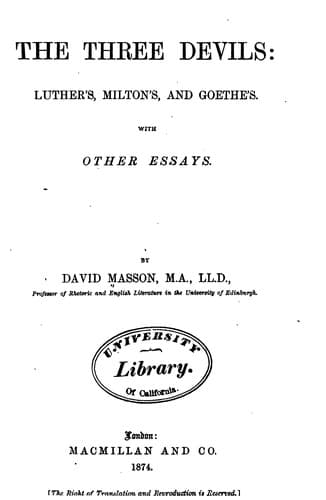
The Three Devils: Luther's, Milton's, and Goethe's; With Other EssaysMasson, David
History
The Three Devils: Luther's, Milton's, and Goethe's; With Other Essays
Masson, David
Devil in literature; Literature -- History and criticism
Some of the ways in which Literature may illustrate History are obvious
enough. In the poems, the songs, the dramas, the novels, the satires, the
speeches, even the speculative treatises, of any time or nation, there is
imbedded a wealth of direct particulars respecting persons and events,
additional to the information that has been transmitted in the formal
records of that time or nation, or in its express histories of itself. "It
has often come to my ears that it is a saying too frequently in your mouth
that you have lived long enough for yourself:" so did Cicero, if the
speech in which the passage occurs is really his, address Cæsar face to
face, in the height of his power, and not long before his assassination,
remonstrating with him on his melancholy, and his carelessness of a life
so precious to Rome and to the world. If the words are any way authentic,
what a flash they are into the mind of the great Roman in his last years,
when, _blasé_ with wars and victories, and all the sensations that the
largest life on earth could afford, he walked about the streets of Rome,
consenting to live on so long as there might be need, but, so far as he
himself was concerned, heedless when the end might come, the conspirators
in a ring round him, the short scuffle, the first sharp stab of the
murderous knife!
Let this pass as one instance of a valuable illustration of Biography and
History derived from casual reading. Literature teems with such: no one
can tell what particles of direct historical and biographical information
lie yet undiscovered and unappropriated in miscellaneous books. But there
is an extension of the use for the historian of the general literature of
the time with which he may be concerned. Not only does Literature teem
with yet unappropriated anecdotes respecting the persons and events of
most prominent interest in the consecutive history of the world; but quite
apart from this, the books, and especially the popular books, of any time,
are the richest possible storehouses of the kind of information the
historian wants. Whatever may be the main thread of his narrative, he has
to re-imagine more or less vividly what is called the general life of the
time, its manners, customs, humours, ways of thinking, the working of its
institutions, all the peculiarities of that patch of the never-ending,
ever-changing rush and bustle of human affairs, to-day above the ground,
and to-morrow under. Well, here in the books of the time he has his
materials and aids. They were formed in the conditions of the time; the
time played itself into them; they are saturated with its spirit; and
costumes, customs, modes of eating and drinking, town-life, country life,
the traveller on horseback to his inn, the shoutings of mobs in riot, what
grieved them, what they hated, what they laughed at, all are there. No
matter of what kind the book is, or what was its author's aim; it is, in
spite of itself, a bequest out of the very body and being of that time,
Public-domain text, read in full here on John Shaqi.
Reviews
Reviews
No reviews yet
Be the first to share your thoughts on this work.
Elsewhere in the archive
Join the Discussion
Join the discussion
Sign in to leave a comment or review.
Sign InorCreate an account