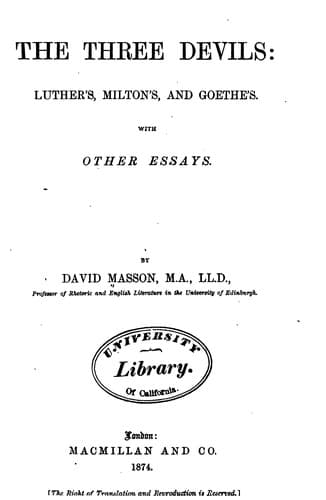
The Three Devils: Luther's, Milton's, and Goethe's; With Other EssaysMasson, David
History
The Three Devils: Luther's, Milton's, and Goethe's; With Other Essays
Masson, David
Devil in literature; Literature -- History and criticism
think so); but somehow they contrived to be such that the world doubts to
this day whether, on the whole, at any time since, it has exhibited, in
such close grouping, such a constellation of spirits of the highest
magnitude. And the lesson enforced by this Greek instance may be enforced,
less blazingly perhaps, but still clearly, as by the light of scattered
stars, by instances from the whole course of historic time. Within that
range, despite the vicissitudes of the mode of human thought caused by
continued inquisitiveness and its results in new knowledges, despite the
change from age to age in mankind's very image of its own whereabouts in
space, and the extent of that whereabouts, and the complexity of the
entanglement in which it rolls, it is still true that you may probe at any
point with the sure expectation of finding at least _some_ minds as good
intrinsically, as strong, as noble, as valiant, as inventive, as any in
our own age of latest appearances and all the newest lights. I am aware,
of course, where the compensation may be sought. The philosophical
historian may contend that, though some minds of early ages have been as
able intrinsically as any minds of later ages, these later minds being
themselves the critics and judges, yet an enormous general progress may be
made out in the increased _number_ in the later ages of minds tolerably
able, in the heightening of the general level, in the more equable
diffusion of intelligence, in the gradual extension of freedom, and the
humanizing of manners and institutions. On that question I am not called
upon to enter now, nor is my opinion on it to be inferred from anything I
am now saying. I limit myself to the assertion that within historic time
we find what we are obliged to call an intrinsic co-equality of _some_
minds at various successive points and at long-separated intervals, and
that consequently, if the human race _is_ gradually acquiring a power of
producing individuals more able than their ablest predecessors, the rate
of its law in this respect is so slow that 2,500 years have not made the
advance appreciable. The assertion is limited; it is reconcilable, I
believe, with the most absolute and extreme doctrine of evolution; but it
seems to be both important and curious, inasmuch as it has not yet been
sufficiently attended to in any of the phrasings of that doctrine that
have been speculatively put forward. No doctrine is rightly phrased, I
would submit, when, if it were true according to that phrasing, it would
be man's highest duty to proceed as if it weren't.
Public-domain text, read in full here on John Shaqi.
Reviews
Reviews
No reviews yet
Be the first to share your thoughts on this work.
Elsewhere in the archive
Join the Discussion
Join the discussion
Sign in to leave a comment or review.
Sign InorCreate an account