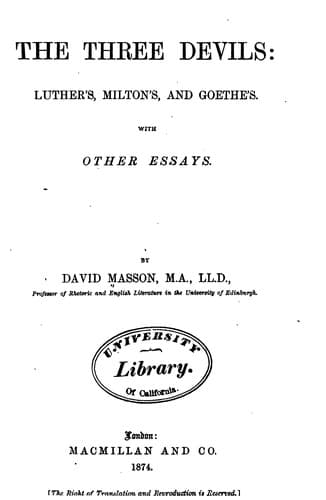
The Three Devils: Luther's, Milton's, and Goethe's; With Other EssaysMasson, David
History
The Three Devils: Luther's, Milton's, and Goethe's; With Other Essays
Masson, David
Devil in literature; Literature -- History and criticism
In the very course of this train of thinking Satan begins to degenerate
into a meaner being. He is on the very threshold of that career in which
he will cease for ever to be the Archangel and become irrevocably the
Devil. The very manner in which he tempts the first pair is devil-like. It
is in the shape of a cormorant on a tree that he sits watching his
victims. He sat at the ear of Eve "squat like a toad." It was in the shape
of a serpent that he tempted her. And, when the evil was done, he slunk
away through the brushwood. In the very act of ruining Man he committed
himself to a life of ignominious activity: he was to go on his belly and
eat dust all his days.
* * * * *
Such is the story of Milton's Satan. It will be easy to express more
precisely the idea which we have acquired of him when we come to contrast
him with Goethe's Mephistopheles. Meanwhile, we shall be much assisted in
our efforts to conceive Goethe's Mephistopheles by keeping in mind what we
have been saying about Milton's Satan.
We do not think it possible to sum up in a single expression all that
Goethe meant to signify by his Mephistopheles. For one thing, it is
questionable whether Goethe kept strictly working out one specific meaning
and making it clearer all through Mephistopheles's gambols and devilries,
or whether, having once for all allegorized the Spirit of Evil into a
living personage, he did not treat him just as he would have treated any
other of his characters, making him always consistent, always diabolic,
but not intent upon making his actions run parallel to any under-current
of exposition. It may be best, therefore, to take Mephistopheles as a
character in a drama which we wish to study. On the whole, perhaps, we
shall be on the right track if, in the first place, we establish a
relation between Satan and Mephistopheles by adopting the notion which we
have imagined Satan himself to have entertained when engaged in scheming
out his future life, _i.e._ if we suppose Mephistopheles to be what Satan
has become after six thousand years. Milton's Satan, then, is the ruined
Archangel deciding his future function, and forswearing all interest in
other regions of the universe, in order that he may more thoroughly
possess and impregnate this. Goethe's Mephistopheles is this same being
after the toils and vicissitudes of six thousand years in his new
vocation: smaller, meaner, ignobler, but a million times sharper and
cleverer. By way of corroboration of this view, we may refer, in passing,
to the Satan of the _Paradise Regained_; who, though still a sublime and
Miltonic being, dealing in high thoughts and high arguments, yet seems to
betray, in his demeanour, the effects of four thousand years spent in a
new walk. Is there not something Mephistopheles-like, for instance, in the
description of the Fiend's appearance when he approached Christ to begin
his temptation? Christ was walking alone and thoughtful one evening in the
Public-domain text, read in full here on John Shaqi.
Reviews
Reviews
No reviews yet
Be the first to share your thoughts on this work.
Join the Discussion
Join the discussion
Sign in to leave a comment or review.
Sign InorCreate an account