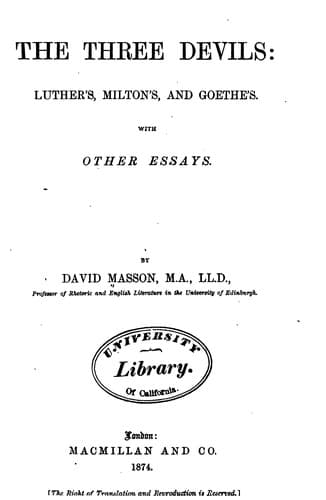
The Three Devils: Luther's, Milton's, and Goethe's; With Other Essays — John Shaqi
The Three Devils: Luther's, Milton's, and Goethe's; With Other EssaysMasson, David
History
The Three Devils: Luther's, Milton's, and Goethe's; With Other Essays
Masson, David
Devil in literature; Literature -- History and criticism
thick of the forest where he had lived fasting forty days, when he heard
the dry twigs behind him snapping beneath approaching footsteps. He turned
round, and
"An aged man in rural weeds,
Following as seemed the quest of some stray ewe,
Or withered sticks to gather, which might serve
Against a winter's day when winds blow keen
To warm him, wet returned from field at eve,
He saw approach; who first with curious eye
Perused him, then with words thus uttered spake."
Observe how all the particulars of this description are drawn out of the
very thick of the civilization of the past four thousand years, and how
the whole effect of the picture is to suggest a Mephistophelic-looking
man, whom it would be disagreeable to meet alone. Indeed, if one had
space, one could make more use of the _Paradise Regained_ as exhibiting
the transition of Satan into Mephistopheles. But we must pass at once to
Goethe.
Viewing Mephistopheles in the proposed light (of course it is not
pretended that Goethe himself had any such idea about his Mephistopheles),
we obtain a good deal of insight from the "Prologue in Heaven." For here
we have Mephistopheles out of his element, and contrasted with his old
co-equals. The scene is Miltonic. The Heavenly Hosts are assembled round
the throne, and the three Archangels, Raphael, Gabriel, and Michael, come
forward to praise the Lord. The theme of their song is Creation--not, as
it would have been in Milton, as an event about to take place, and which
would vary the monotony of the universe, but as a thing existing and
grandly going on. It is to be noted too that, while Milton appeals chiefly
to the sight, and is clear and coherent in his imagery, Goethe produces a
similar effect in his own manner by appealing to sight and hearing
simultaneously, making sounds and metaphors dance and whirl through each
other, as in a wild, indistinct, but overpowering dream. Raphael describes
the Sun rolling on in thunder through the heavens, singing in chorus with
the kindred stars. Gabriel describes the Earth revolving on her axis, one
hemisphere glittering in the light, the other dipped in shadow. Michael in
continuation sings of the ensphering atmosphere and the storms that rage
in it, darting forth tongues of lightning, and howling in gusts over land
and sea. And then the three burst forth in symphony, exulting in their
nature as beings deriving strength from serene contemplation, and
proclaiming all God's works to be as bright and glorious as on the day
they were created. Suddenly, while Heaven is still thrilling to the grand
undulation, another voice breaks in:
"Da du, O Herr, dich einmal wieder nahst,
Und fragst wie alles sich bei uns befinde,
Und du mich sonst gewöhnlich gerne sahst,
So siehst du mich auch unter dem Gesinde."
Public-domain text, read in full here on John Shaqi.
Reviews
Reviews
No reviews yet
Be the first to share your thoughts on this work.
Join the Discussion
Join the discussion
Sign in to leave a comment or review.
Sign InorCreate an account