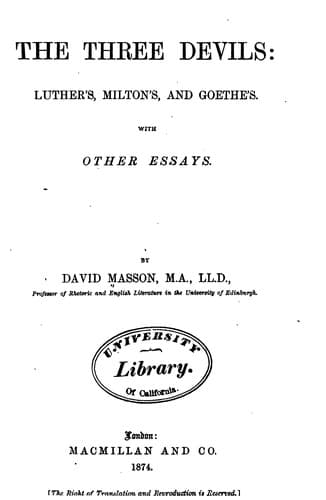
The Three Devils: Luther's, Milton's, and Goethe's; With Other EssaysMasson, David
History
The Three Devils: Luther's, Milton's, and Goethe's; With Other Essays
Masson, David
Devil in literature; Literature -- History and criticism
Luther, Milton, and Goethe: these are very strange names to bring
together. It strikes us, however, that the effect may not be uninteresting
if we connect the names of those three great men, as having each
represented to us the Principle of Evil, and each represented him in a
different way. Each of the three has left on record his conception of a
great accursed being, incessantly working in human affairs, and whose
function it is to produce evil. There is nothing more striking about
Luther than the amazing sincerity of his belief in the existence of such
an evil being, the great general enemy of mankind, and whose specific
object, in Luther's time, it was to resist Luther's movement, and, if
possible, "cut his soul out of God's mercy." What was Luther's exact
conception of this being is to be gathered from his life and writings.
Again, we have Milton's Satan. Lastly, we have Goethe's Mephistopheles.
Nor is it possible to confound the three, or for a moment to mistake the
one for the other. They are as unlike as it is possible for three grand
conceptions of the same thing to be. May it not, then, be profitable to
make their peculiarities and their differences a subject of study?
Milton's Satan and Goethe's Mephistopheles have indeed been frequently
contrasted in a vague, antithetic way; for no writer could possibly give a
description of Goethe's Mephistopheles without saying something or other
about Milton's Satan. The exposition, however, of the difference between
the two has never been sufficient; and it may give the whole speculation
greater interest if, in addition to Milton's Satan and Goethe's
Mephistopheles, we include Luther's Devil. It is scarcely necessary to
premise that here there is to be no theological discussion. All that we
propose is to compare, as we find them, three very striking delineations
of the Evil Principle, one of them experimental, the other two poetical.
* * * * *
Public-domain text, read in full here on John Shaqi.
Reviews
Reviews
No reviews yet
Be the first to share your thoughts on this work.
Join the Discussion
Join the discussion
Sign in to leave a comment or review.
Sign InorCreate an account