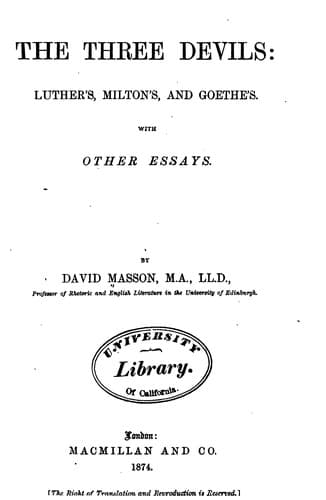
The Three Devils: Luther's, Milton's, and Goethe's; With Other EssaysMasson, David
History
The Three Devils: Luther's, Milton's, and Goethe's; With Other Essays
Masson, David
Devil in literature; Literature -- History and criticism
These last words indicate one respect in which, it will be perceived at
the outset, Luther's conception of the Evil Principle on the one hand and
Milton's and Goethe's on the other are fundamentally distinguishable. All
the three, of course, are founded on the Scriptural proposition of the
existence of a being whose express function it is to produce evil. Luther,
firmly believing every jot and tittle of Scripture, believed the
proposition about the Devil also; and so the whole of his experience of
evil in himself and others was cast into the shape of a verification of
that proposition. Had he started without such a preliminary conception,
his experience would have had to encounter the difficulty of expressing
itself in some other way; which, it is likely, would not have been nearly
so effective, or so Luther-like. Milton, too, borrows the elements of his
conception of Satan from Scripture. The Fallen Angel of the Bible is the
hero of _Paradise Lost_; and one of the most striking things about this
poem is that in it we see the grand imagination of the poet blazing in the
very track of the propositions of the theologian. And, though there can be
no doubt that Goethe's Mephistopheles is conceived less in the spirit of
Scripture than either Milton's Satan or Luther's Devil, still even in
Mephistopheles we discern the lineaments of the same traditional being.
All the three, then, have this in common--that they are founded on the
Scriptural proposition of the existence of an accursed being whose
function it is to produce evil, and that, more or less, they adopt the
Scriptural account of that being. Still, as we have said, Luther's
conception of this being belongs to one category; Milton's and Goethe's
to another. Luther's is a biographical phenomenon; Milton's and Goethe's
are literary performances. Luther illustrated the Evil Being of Scripture
to himself by means of his personal experience. Whatever resistance he met
with, whatever obstacle to Divine grace he found in his own heart or in
external circumstances, whatever event he saw plainly cast in the way of
the progress of the Gospel, whatever outbreak of a bad or unamiable spirit
occurred in the Church, whatever strange phenomenon of nature wore a
malevolent aspect,--out of that he obtained a clearer notion of the Devil.
In this way it might be said that Luther was all his life gaining a deeper
insight into the Devil's character. On the other hand, Milton's Satan and
Goethe's Mephistopheles are poetical creations, the one epic, the other
dramatic. Borrowing the elements of his conception from Scripture, Milton
set himself to the task of describing the ruined Archangel as he may be
supposed to have existed at that epoch of the creation when he had hardly
decided his own function, as yet warring with the Almighty, or, in pursuit
of a gigantic scheme of revenge, travelling from star to star. Poetically
assuming the device of the same Scriptural proposition, Goethe set himself
Public-domain text, read in full here on John Shaqi.
Reviews
Reviews
No reviews yet
Be the first to share your thoughts on this work.
Join the Discussion
Join the discussion
Sign in to leave a comment or review.
Sign InorCreate an account