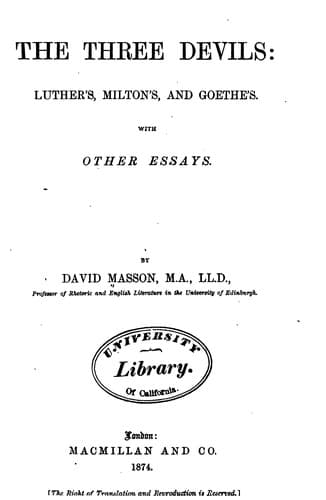
The Three Devils: Luther's, Milton's, and Goethe's; With Other EssaysMasson, David
History
The Three Devils: Luther's, Milton's, and Goethe's; With Other Essays
Masson, David
Devil in literature; Literature -- History and criticism
Now this speech both announces and exhibits Mephistopheles's nature.
Without even knowing the language, one could hardly hear the original read
as Mephistopheles's without seeing in it shamelessness, impudence,
volubility, cleverness, a sneering, sarcastic disposition, want of heart,
want of sentiment, want of earnestness, want of purpose, complete,
confirmed, irrecoverable devilishness. And, besides, Mephistopheles
candidly describes himself in it. When, in sly and sarcastic allusion to
the song of the Archangels, he tells that _he_ has not the gift of talking
fine, he announces in effect that he is not going to be Miltonic. _He_ is
not going to speak of suns and universes, he says. Raphael, Gabriel, and
Michael, are at home in that sort of thing; but _he_ is not. Leaving them,
therefore, to tell how the universe is flourishing on the grand scale, and
how the suns and the planets are going on as beautifully as ever, he will
just say a word or two as to how human nature is getting on down yonder;
and, to be sure, if comparison be the order of the day, the little godkin,
Man, is quite as odd as on the day he was made. And at once, with
astounding impudence, he launches into a train of remark the purport of
which is that everything down below is at sixes and sevens, and that in
his opinion human nature has turned out a failure. And, heedless of the
disgust of his audience, he would go on talking for ever, were he not
interrupted.
And is this the Satan of the _Paradise Lost_? Is this the Archangel
ruined? Is this the being who warred against the Almighty, who lay
floating many a rood, who shot upwards like a pyramid of fire, who
navigated space wherever he chose, speeding on his errands from star to
star, and who finally conceived the gigantic scheme of assaulting the
universe where it was weakest, and impregnating the new creation with the
venom of his spirit? Yes, it is he; but oh, how changed! For six thousand
years he has been pursuing the walk he struck out at the beginning, plying
his self-selected function, dabbling devilishly in human nature, and
abjuring all interest in the grander physics; and the consequence is, as
he himself anticipated, that his nature, once great and magnificent, has
become small, virulent, and shrunken,
"Subdued
To what it works in, like the dyer's hand."
Public-domain text, read in full here on John Shaqi.
Reviews
Reviews
No reviews yet
Be the first to share your thoughts on this work.
Join the Discussion
Join the discussion
Sign in to leave a comment or review.
Sign InorCreate an account