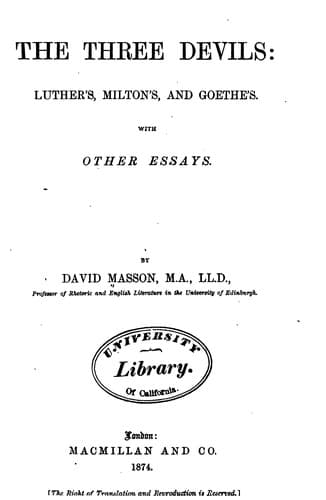
The Three Devils: Luther's, Milton's, and Goethe's; With Other EssaysMasson, David
History
The Three Devils: Luther's, Milton's, and Goethe's; With Other Essays
Masson, David
Devil in literature; Literature -- History and criticism
As if he had been journeying through a wilderness of scorching sand, all
that was left of the Archangel has long since evaporated. He is now a dry,
shrivelled up, scoffing spirit. When, at the moment of scheming out his
future existence and determining to become a Devil, he anticipated the
ruin of his nature, he could not help thinking with what a strange feeling
he should then appear before his old co-equals, Raphael, Gabriel, and
Michael. But now he stands before them disgustingly unabashed, almost
ostentatious of not being any longer an Archangel. Even in the days of his
glory he was different from them. They luxuriated in contemplation; he in
the feeling of innate all-sufficient vigour. And lo, now! They are
unchanged, the servants of the Lord, revering the day's gentle going. He,
the scheming, enthusiastic Archangel, has been soured and civilized into
the clever cold-hearted Mephistopheles.
Mephistopheles is the Spirit of Evil in modern society. Goethe's _Faust_
is an illustration of this spirit's working in the history of an
individual. The case selected is a noble one. Faust, a man of grand and
restless nature, is aspiring after universality of feeling. Utterly
dissatisfied and disgusted with all human method and all human
acquisition, nay, fretting at the constitution of human nature itself, he
longs to spill out his soul, so that, mingling with the winds, it may
become a part of the ever-thrilling spirit of the universe and know the
essence of everything. He has been contemplating suicide. To this great
nature struggling with itself Mephistopheles is linked. It is to be noted
that throughout the whole drama there is no evidence that it was an object
of very earnest solicitude with Mephistopheles to gain possession of the
soul of Faust. Of course, he desired this, and had it in view. Thus, he
exacted a bond from Faust; and we find him also now and then chuckling
when alone in anticipation of Faust's ultimate ruin. But on the whole he
is constant to no earnest plan for effecting it. In fact, he is constant
to no single purpose whatever. The desire of doing devilry is his motive
all through. Going about with Faust was but being in the way of business
and having a companion at the same time. He studies his own gratification,
not Faust's, in all that he does. Faust never gets what he had a right to
expect from him. He is dragged hither and thither through scenes he has no
anxiety to be in, merely that Mephistopheles may enjoy some new and
_piquant_ piece of devilry. The moment he and Faust enter any place, he
quits Faust's side and mixes with the persons present, to do some mischief
or other; and, when it is done, he comes back to Faust, who has been
standing, with his arms folded, gloomily looking on, and asks him if he
could desire any better amusement than this. Now this is not the conduct
of a devil intent upon nothing so much as gaining possession of the soul
of his victim. A Miltonic devil would have pressed on to the mark more. He
Public-domain text, read in full here on John Shaqi.
Reviews
Reviews
No reviews yet
Be the first to share your thoughts on this work.
Join the Discussion
Join the discussion
Sign in to leave a comment or review.
Sign InorCreate an account