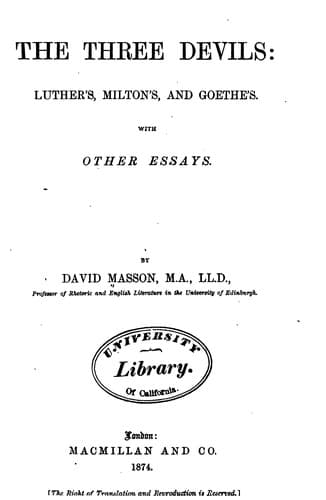
The Three Devils: Luther's, Milton's, and Goethe's; With Other EssaysMasson, David
History
The Three Devils: Luther's, Milton's, and Goethe's; With Other Essays
Masson, David
Devil in literature; Literature -- History and criticism
would have been more self-denying, and would have kept his victim in
better humour. But Mephistopheles is a devil to the very core. He is a
devil in his conduct to Faust. What he studies is not to gratify Faust,
but to find plenty of congenial occupation for himself, to perpetrate as
great a quantity of evil as possible in as short a time as possible. It
seems capable of being inferred from this peculiarity in the character of
Mephistopheles that Goethe had in his mind all through the poem a certain
under-current of allegoric meaning. One sees that Mephistopheles, though
acting as a dramatic personage, represents an abstract something or other.
The character of Mephistopheles is brought out all through the drama. In
the first and second parts we have Faust and him brought into a great
variety of situations and into contact with a great variety of
individuals; and in watching how Mephistopheles conducts himself in these
we obtain more and more insight into his devilish nature. He manifests
himself in two ways--by his style of speaking, and by his style of acting.
That is to say, Mephistopheles, in the first place, has a habit of making
observations upon all subjects, and throwing out all kinds of general
propositions in the course of his conversation, and by attending to the
spirit of these one can perceive very distinctly his mode of looking at
things; and, in the second place, he acts a part in the drama, and this
part is, of course, characteristic.
The distinguishing feature in Mephistopheles's conversation is the amazing
intimacy which it displays with all the conceivable ways in which crime
can be perpetrated. There is positively not a wrong thing that people are
in the habit of doing that he does not seem to be aware of. He is profound
in his acquaintance with iniquity. If there is a joint loose anywhere in
society, he knows of it; if the affairs of the State are going into
confusion because of some blockhead's mismanagement, he knows of it. He is
versed in all the forms of professional quackery. He knows how pedants
hoodwink people, how priests act the hypocrite, how physicians act the
rake, how lawyers peculate. In all sorts of police information he is a
perfect Fouché. He has gone deep enough into one fell subject to be able
to write a book like Duchatelet's. And not only has he accumulated a mass
of observations, but he has generalized those observations, and marked
evil in its grand educational sources. If the human mind is going out into
a hopeless track of speculation, he has observed and knows it. If the
universities are frittering away the intellect of the youth of a country
in useless and barren studies, he knows it. If atheistic politicians are
vehemently defending the religious institutions of a country, he has
marked the prognostication. Whatever promises to inflict misery, to lead
people astray, to break up beneficial alliances, to make men flounder on
in error, to cause them to die blaspheming at the last, he is thoroughly
Public-domain text, read in full here on John Shaqi.
The Three Devils: Luther's, Milton's, and Goethe's; With Other Essays — John Shaqi
Reviews
Reviews
No reviews yet
Be the first to share your thoughts on this work.
Join the Discussion
Join the discussion
Sign in to leave a comment or review.
Sign InorCreate an account