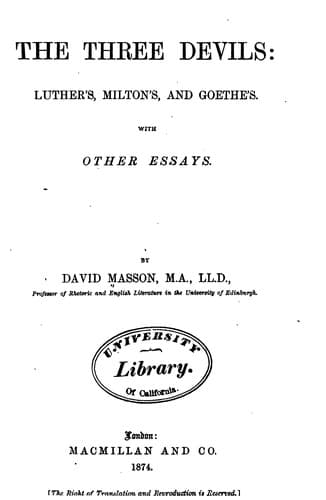
The Three Devils: Luther's, Milton's, and Goethe's; With Other Essays — John Shaqi
The Three Devils: Luther's, Milton's, and Goethe's; With Other EssaysMasson, David
History
The Three Devils: Luther's, Milton's, and Goethe's; With Other Essays
Masson, David
Devil in literature; Literature -- History and criticism
Respecting the part which Mephistopheles performs in the drama we have
already said something. Going about the world, linked to Faust, is to him
only a racy way of acting the devil. Having as his companion a man so
flighty in his notions did but increase the flavour of whatever he engaged
in. All through he is laughing in secret at Faust, and deriving a keen
enjoyment from his transcendental style of thinking. Faust's noble
qualities are all Greek and Gaelic to his cold and devilish nature. He
has a contempt for all strong feeling, all sentiment, all evangelism. He
enjoys the Miltonic vastly. Thus in the "Prologue in Heaven" he quizzes
the Archangels about the grandiloquence of their song. Not that he does
not understand that sort of thing intellectually, but that it is not in
his nature to sympathize with anything like sentiment. Hence, when he
assumes the sentimental himself and mimicks any lofty strain, although he
does it full justice in as far as giving the whole intellectual extent of
meaning is concerned, yet he always does so in words so inappropriate
emotionally that the effect is a parody. He must have found amusement
enough in Faust's company to have reconciled him in some measure to losing
him finally.
But to go on. Mephistopheles acts the devil all through. In the first
place he acts the devil to Faust himself, for he is continually taking his
own way and starting difficulties whenever Faust proposes anything. Then
again in his conduct towards the other principal personages of the drama
it is the same. In the murder of poor Margaret, her mother, her child, and
her brother, we have as fiendish a series of acts as devil could be
supposed capable of perpetrating. And, lastly, in the mere filling up and
side play, it is the same. He is constantly doing unnecessary mischief. If
he enters Auerbach's wine-cellar and introduces himself to the four
drinking companions, it is to set the poor brutes fighting and make them
cut off each other's noses. If he spends a few minutes in talk with
Martha, it is to make the silly old woman expose her foibles. The Second
Part of Faust is devilry all through, a tissue of bewilderments and
devilries. And while doing all this Mephistopheles is still the same cold,
self-possessed, sarcastic being. If he exhibits any emotion at all, it is
a kind of devilish anger. Perhaps, too, once or twice we recognise
something like terror or flurry. But on the whole he is a spirit bereft of
feeling. What could indicate the heart of a devil more than his words to
Faust in the harrowing prison scene?
"Komm, komm, ich lasse dich mit ihr im Stich."
* * * * *
Public-domain text, read in full here on John Shaqi.
Reviews
Reviews
No reviews yet
Be the first to share your thoughts on this work.
Join the Discussion
Join the discussion
Sign in to leave a comment or review.
Sign InorCreate an account