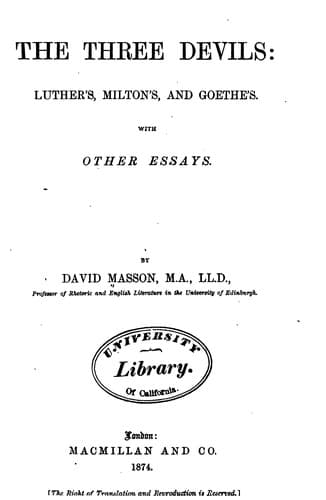
The Three Devils: Luther's, Milton's, and Goethe's; With Other EssaysMasson, David
History
The Three Devils: Luther's, Milton's, and Goethe's; With Other Essays
Masson, David
Devil in literature; Literature -- History and criticism
And now for a word or two describing Milton's Satan and Goethe's
Mephistopheles by each other:--Satan is a colossal figure; Mephistopheles
an elaborated portrait. Satan is a fallen Archangel scheming his future
existence; Mephistopheles is the modern Spirit of Evil. Mephistopheles has
a distinctly marked physiognomy; Satan has not. Satan has a sympathetic
knowledge of good; Mephistopheles knows good only as a phenomenon. Much of
what Satan says might be spoken by Raphael; a devilish spirit runs through
all that Mephistopheles says. Satan's bad actions are preceded by noble
reasonings; Mephistopheles does not reason. Satan's bad actions are
followed by compunctious visitings; Mephistopheles never repents. Satan is
often "inly racked;" Mephistopheles can feel nothing more noble than
disappointment. Satan conducts an enterprise; Mephistopheles enjoys an
occupation. Satan has strength of purpose; Mephistopheles is volatile.
Satan feels anxiety; Mephistopheles lets things happen. Satan's greatness
lies in the vastness of his motives; Mephistopheles's in his intimate
acquaintance with everything. Satan has a few sublime conceptions;
Mephistopheles has accumulated a mass of observations. Satan declaims;
Mephistopheles puts in remarks. Satan is conversant with the moral aspects
of things and uses adjectives; Mephistopheles has a preference for nouns,
and uses adjectives only to convey significations which he _knows_ to
exist. Satan may end in being a devil; Mephistopheles is a devil
irrecoverably.
* * * * *
Public-domain text, read in full here on John Shaqi.
Reviews
Reviews
No reviews yet
Be the first to share your thoughts on this work.
Join the Discussion
Join the discussion
Sign in to leave a comment or review.
Sign InorCreate an account