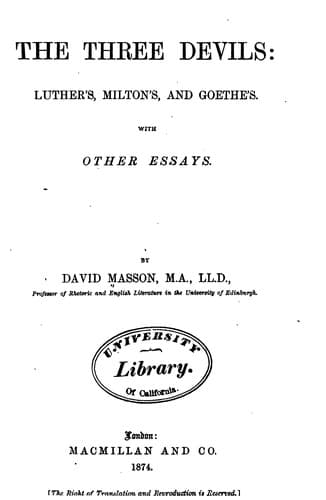
The Three Devils: Luther's, Milton's, and Goethe's; With Other EssaysMasson, David
History
The Three Devils: Luther's, Milton's, and Goethe's; With Other Essays
Masson, David
Devil in literature; Literature -- History and criticism
become acquainted with the character of our invisible correspondent and
nightly visitant; still we could arrive at a few conclusions respecting
him, and the more of his workmanship we saw the more insight we should
come to have. Or again, in striving to realize to himself the Scriptural
proposition about the Devil, Luther, to speak in the language of the
"Positive Philosophy," was but striving to ascertain the laws according to
which evil happens. Only the Positive Philosophy would lay a veto on any
such speculation, and pronounce it fundamentally vicious in this
respect--that there are not two courses of events, separable from each
other, in history, the one good and the other evil, but that evil comes of
good and good of evil; so that, if we are to have a science of history at
all, the most we can have is a science of the laws according to which, not
evil follows evil, but events follow each other. But History to Luther was
not a physical course of events. It was God acting, and the Devil
opposing.
So far Luther did not differ from his age. Belief in Satanic agency was
universal at that period. We have no idea now how powerful this belief
was. We realize something of the truth when we read the depositions in an
old book of trials for witchcraft. But it is sufficient to glance over any
writings of the period to see what a real meaning was then attached to the
words "Hell" and "Devil." The spirit of these words has become obsolete,
chased away by the spirit of exposition. That was what M. Comte calls the
Theological period, when all the phenomena of mind and matter were
referred to the agency of Spirits. The going out of the belief in Satanic
agency (for even those who retain it in profession allow it no force in
practice) M. Comte would attribute to the progress of the spirit of that
philosophy of which he is the apostle. We do not think, however, that the
mere progress of the scientific spirit--that is, the mere disposition of
men to pursue one mode of thinking with respect to all classes of
phenomena--could have been sufficient of itself to work such an alteration
in the general mind. We are fond of accounting for it, in part at least,
by the going out, in the progress of civilization, of those sensations
which seem naturally fitted to nourish the belief in supernatural beings.
The tendency of civilization has been to diminish our opportunities of
feeling terror, of feeling strongly at all. The horrific plays a much less
important part in human experience than it once did. To mention but a
single instance: we are exempted now, by mechanical contrivances for
locomotion, &c., from the necessity of being much in darkness or wild
physical solitude. This is especially the case with those who dwell in
cities, and therefore exert most conspicuously an intellectual influence.
The moaning of the wind at night in winter is about their highest
experience of the kind; and is it not a corroboration of the view now
Public-domain text, read in full here on John Shaqi.
Reviews
Reviews
No reviews yet
Be the first to share your thoughts on this work.
Join the Discussion
Join the discussion
Sign in to leave a comment or review.
Sign InorCreate an account