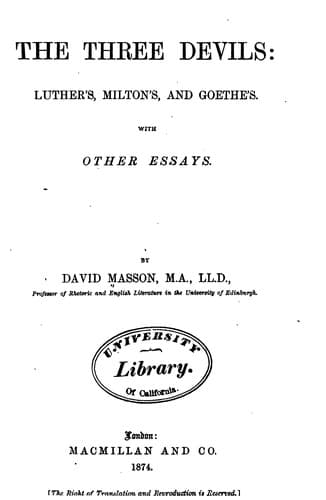
The Three Devils: Luther's, Milton's, and Goethe's; With Other EssaysMasson, David
History
The Three Devils: Luther's, Milton's, and Goethe's; With Other Essays
Masson, David
Devil in literature; Literature -- History and criticism
Milton's Satan and Goethe's Mephistopheles are literary performances; and,
for what they prove, neither Milton nor Goethe need have believed in a
Devil at all. Luther's Devil, on the other hand, was a being recognised by
him as actually existing--as existing, one might say, with a vengeance.
The strong conviction which Luther had on this point is a feature in his
character. The narrative of his life abounds in anecdotes showing that the
Devil with him was no chimera, no mere orthodoxy, no fiction. In every
page of his writings we have the word _Teufel_, _Teufel_, repeated again
and again. Occasionally there occurs an express dissertation upon the
nature and functions of the Evil Spirit; and one of the longest chapters
in his _Table Talk_ is that entitled "The Devil and his Works"--indicating
that his conversation with his friends often turned on the subject of
Satanic agency. _Teufel_ was actually the strongest signification he had;
and, whenever he was excited to his highest emotional pitch, it came in to
assist his utterance at the climax, and give him a correspondingly
powerful expression. "This thing I will do," it was common for him to say,
"in spite of all who may oppose me, be it duke, emperor, priest, bishop,
cardinal, pope, or Devil." Man's heart, he says, is a "Stock, Stein,
Eisen, Teufel, hart Herz," ("a stock, stone, iron, Devil, hard heart").
And it was not a mere vague conception he had of this being, such as
theology might oblige. On the contrary, he had observed him as a man would
his personal enemy, and in so doing had formed a great many conclusions
respecting his powers and his character. In general, Luther's Devil may be
defined as a personification, in the spirit of Scripture, of the resisting
medium which Luther had to toil his way through--spiritual fears,
passionate uprisings, fainting resolutions within himself; error,
weakness, envy, in those around him; and, without, a whole world howling
for his destruction. It is in effect as if Luther had said, "Scripture
reveals to me the existence of a great accursed Being, whose function it
is to produce evil. It is for me to ascertain the character of this Being,
whom I, of all men, have to deal with. And how am I to do so except by
observing him working? God knows I have not far to go in search of his
manifestations." And thus Luther went on filling up the Scriptural
proposition with his daily experience. He was constantly gaining a clearer
conception of his great personal antagonist, constantly stumbling upon
some more concealed trait in the Spirit's character. The Being himself was
invisible; but men were walking in the midst of his manifestations. It was
as if there were some Being whom we could not see, nor directly in the
ordinary way have any intercourse with, but who every morning, before it
was light, came and left at our doors some exquisite specimen of his
workmanship. It would, of course, be difficult under such disadvantages to
Public-domain text, read in full here on John Shaqi.
Reviews
Reviews
No reviews yet
Be the first to share your thoughts on this work.
Join the Discussion
Join the discussion
Sign in to leave a comment or review.
Sign InorCreate an account