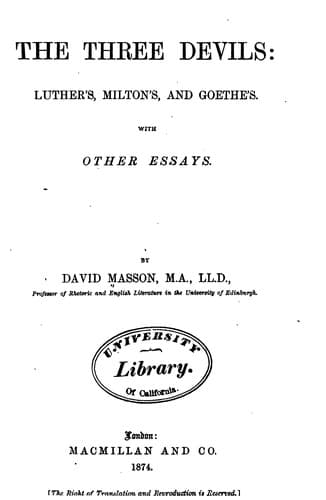
The Three Devils: Luther's, Milton's, and Goethe's; With Other EssaysMasson, David
History
The Three Devils: Luther's, Milton's, and Goethe's; With Other Essays
Masson, David
Devil in literature; Literature -- History and criticism
Goethe's face is different. The whole size of the head is perhaps less,
but the proportion of the face to the head is greater, and there is more
of that determinate form which arises from prominence and strength in the
bony structure. The features are individually larger, and present in their
combination more of that deliberate beauty of outline which can be
conveyed with effect in sculpture. The expression, however, is also that
of calm intellectual repose; and, in the absence of harshness or undue
concentration of the parts, one is at liberty to discover the proof that
this also was the face of a man whose life was spent rather in a career of
thought and literary effort than in a career of active and laborious
strife. Yet the face, with all its power of fine susceptibility, is not so
passive as that of Shakespeare. Its passiveness is more the passiveness of
self-control, and less that of natural constitution; the susceptibilities
pass and repass over a firmer basis of permanent character; the tremors
among the nervous tissues do not reach to such depths of sheer nervous
dissolution, but sooner make impact against the solid bone. The calm in
the one face is more that of habitual softness and ease of humour; the
calm in the other is more that of dignified, though tolerant,
self-composure. It would have been more easy, one thinks, to take
liberties with Shakespeare in his presence than to attempt a similar thing
in the presence of Goethe. The one carried himself with the air of a man
often diffident of himself, and whom, therefore, a foolish or impudent
stranger might very well mistake till he saw him roused; the other wore,
with all his kindness and blandness, a fixed stateliness of mien and look
that would have checked undue familiarity from the first. Add to all this
that the face of Goethe, at least in later life, was browner and more
wrinkled; his hair more dark; his eye also nearer the black and lustrous
in species, if less mysteriously vague and deep; and his person perhaps
the taller and more symmetrically made.[3]
But a truce to these guesses! What do we actually know respecting those
two men, whose masks, the preserved similitudes of the living features
with which they once fronted the world, are now before us? Let us turn
first to the one and then to the other, till, as we gaze at these poor
eyeless images, which are all we now have, some vision of the lives and
minds they typify shall swim into our ken.
* * * * *
Public-domain text, read in full here on John Shaqi.
Reviews
Reviews
No reviews yet
Be the first to share your thoughts on this work.
Join the Discussion
Join the discussion
Sign in to leave a comment or review.
Sign InorCreate an account