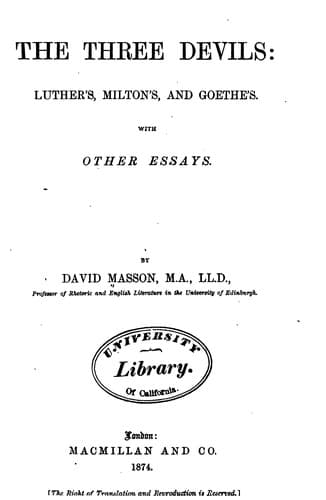
The Three Devils: Luther's, Milton's, and Goethe's; With Other Essays — John Shaqi
The Three Devils: Luther's, Milton's, and Goethe's; With Other EssaysMasson, David
History
The Three Devils: Luther's, Milton's, and Goethe's; With Other Essays
Masson, David
Devil in literature; Literature -- History and criticism
Shakespeare, this Englishman who died two hundred and sixty years ago,
what is he now to us his countrymen, who ought to know him best? A great
name, in the first place, of which we are proud! That this little foggy
island of England should have given birth to such a man is of itself a
moiety of our acquittance among the nations. By Frenchmen Shakespeare is
accepted as at least equal to their own first; Italians waver between him
and Dante; Germans, by race more our brethren, worship him as their own
highest product too, though born by chance amongst us. All confess him to
have been one of those great spirits, occasionally created, in whom the
human faculties seem to have reached that extreme of expansion on the
slightest increase beyond which man would burst away into some other mode
of being and leave this behind. And why all this? What are the special
claims of Shakespeare to this high worship? Through what mode of activity,
practised while alive, has he won this immortality after he is dead? The
answer is simple. He was an artist, a poet, a dramatist. Having, during
some five-and-twenty years of a life not very long, written about forty
dramatic pieces, which, after being acted in several London theatres,
were printed either by himself or by his executors, he has, by this means,
bequeathed to the memory of the human race an immense number of verses,
and to its imagination a great variety of ideal characters and
creations--Lears, Othellos, Hamlets, Falstaffs, Shallows, Imogens,
Mirandas, Ariels, Calibans. This, understood in its fullest extent, is
what Shakespeare has done. Whatever blank in human affairs, as they now
are, would be produced by the immediate withdrawal of all this
intellectual capital, together with all the interest that has been
accumulated on it: _that_ is the measure of what the world owes to
Shakespeare.
This conception, however, while it serves vaguely to indicate to us the
greatness of the man, assists us very little in the task of defining his
character. In our attempts to do this--to ascend, as it were, to the
living spring from which have flowed those rich poetic streams--we
unavoidably rely upon two kinds of authority: the records which inform us
of the leading events of his life; and the casual allusions to his person
and habits left us by his contemporaries.
Public-domain text, read in full here on John Shaqi.
Reviews
Reviews
No reviews yet
Be the first to share your thoughts on this work.
Join the Discussion
Join the discussion
Sign in to leave a comment or review.
Sign InorCreate an account