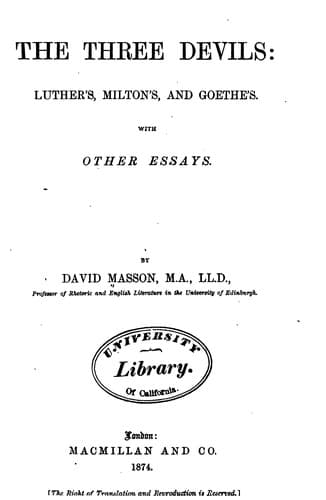
The Three Devils: Luther's, Milton's, and Goethe's; With Other Essays — John Shaqi
The Three Devils: Luther's, Milton's, and Goethe's; With Other EssaysMasson, David
History
The Three Devils: Luther's, Milton's, and Goethe's; With Other Essays
Masson, David
Devil in literature; Literature -- History and criticism
_Aubrey's Sketch of Shakespeare at second hand._--"This William,
being inclined naturally to poetry and acting, came to London, I
guess, about 18; and was an actor at one of the play-houses, and did
act exceedingly well. (Now B. Jonson was never a good actor, but an
excellent instructor.) He began early to make essays at dramatic
poetry, which at that time was very low; and his plays took well. He
was a handsome, well-shaped man; very good company, and of a very
ready and pleasant smooth wit. The humour of the constable in '_A
Midsummer Night's Dream_,' he happened to take at Grendon, in Bucks,
which is the road from London to Stratford; and there was living that
constable about 1642, when I first came to Oxon. Mr. Jos. Howe is of
that parish; and knew him. Ben Jonson and he did gather humours of
men daily wherever they came.... He was wont to go to his native
country once a year. I think I have been told that he left 200_l._ or
300_l._ per annum, there and thereabout, to a sister. I have heard
Sir William Davenant and Mr. Thomas Shadwell, who is accounted the
best comedian we have now, say that he had a most prodigious wit, and
did admire his natural parts beyond all other dramatical writers. He
was wont to say that he never blotted out a line in his life. Said
Ben Jonson, 'I wish he had blotted out a thousand.'"--_Written, about
1680, by John Aubrey, born 1625._
_Ben Jonson's own Sketch of Shakespeare._--"I remember the players
have often mentioned it as an honour to Shakespeare, that in his
writing (whatsoever he penned) he never blotted out a line. My answer
hath been 'Would he had blotted a thousand!'; which they thought a
malevolent speech. I had not told posterity this but for their
ignorance, who chose that circumstance to commend their friend by
wherein he most faulted; and to justify mine own candour: for I loved
the man, and do honour his memory, on this side idolatry, as much as
any. He was, indeed, honest, and of an open and free nature; had an
excellent phantasy, brave notions, and gentle expressions; wherein he
flowed with that facility that _sometimes it was necessary he should
be stopped_: '_Sufflaminandus erat_,' as Augustus said of Haterius.
His wit was in his own power; would the rule of it had been so too!
Many times he fell into those things could not escape laughter; as
when he said, in the person of Cæsar, one speaking to him, 'Cæsar,
thou dost me wrong,' he replied, 'Cæsar did never wrong but with just
cause,' and such like; which were ridiculous. But he redeemed his
vices with his virtues. There was ever more in him to be praised than
to be pardoned."--_Ben Jonson's "Discoveries."_
Public-domain text, read in full here on John Shaqi.
Reviews
Reviews
No reviews yet
Be the first to share your thoughts on this work.
Join the Discussion
Join the discussion
Sign in to leave a comment or review.
Sign InorCreate an account