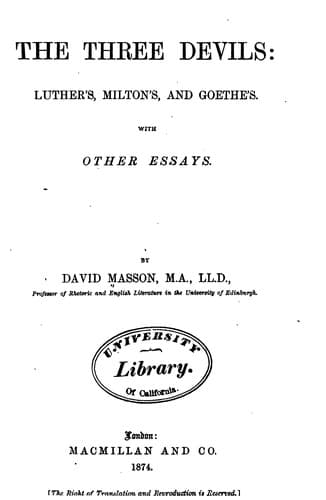
The Three Devils: Luther's, Milton's, and Goethe's; With Other Essays — John Shaqi
The Three Devils: Luther's, Milton's, and Goethe's; With Other EssaysMasson, David
History
The Three Devils: Luther's, Milton's, and Goethe's; With Other Essays
Masson, David
Devil in literature; Literature -- History and criticism
It is sheer nonsense, with these and other such passages accessible to
anybody, to go on repeating, as people seem determined to do, the
hackneyed saying of the commentator Steevens, that "all that we know of
Shakespeare is, that he was born at Stratford-on-Avon; married and had
children there; went to London, where he commenced actor, and wrote plays
and poems; returned to Stratford, made his will, died, and was buried."[4]
It is our own fault, and not the fault of the materials, if we do not know
a great deal more about Shakespeare than that; if we do not realize, for
example, these distinct and indubitable facts about him--his special
reputation among the critics of his time, as a man not so much of
erudition as of prodigious natural genius; his gentleness and openness of
disposition; his popular and sociable habits; his extreme ease, and, as
some thought, negligence in composition; and, above all, and most
characteristic of all, his excessive fluency in speech. "He sometimes
required stopping," is Ben Jonson's expression; and whoever does not see a
whole volume of revelation respecting Shakespeare in that single trait has
no eye for seeing anything. Let no one ever lose sight of that phrase in
trying to imagine Shakespeare.
Still, after all, we cannot be content thus. With regard to such a man we
cannot rest satisfied with a mere picture of his exterior in its aspect of
repose, or in a few of its common attitudes. We seek, as the phrase is, to
penetrate into his heart--to detect and to fix in everlasting portraiture
that mood of his soul which was ultimate and characteristic; in which, so
to speak, he came ready-fashioned from the Creator's hands; towards which
he always sank when alone; and on the ground-melody of which all his
thoughts and actions were but voluntary variations. As far short of such a
result as would be any notion we could form of the poet Burns from a mere
chronological outline of his life, together with a few stories such as are
current about his moral irregularities, so far short of a true
appreciation of Shakespeare would be that idea of him which we could
derive from the scanty fund of the external evidence.
Public-domain text, read in full here on John Shaqi.
Reviews
Reviews
No reviews yet
Be the first to share your thoughts on this work.
Join the Discussion
Join the discussion
Sign in to leave a comment or review.
Sign InorCreate an account