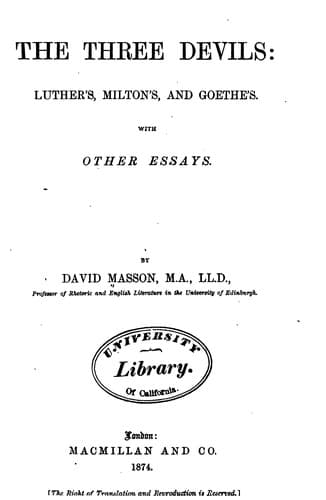
The Three Devils: Luther's, Milton's, and Goethe's; With Other EssaysMasson, David
History
The Three Devils: Luther's, Milton's, and Goethe's; With Other Essays
Masson, David
Devil in literature; Literature -- History and criticism
If Goethe attained this character, however, it was not because, as it is
the fashion to say, he was by nature cold, heartless, and impassive, but
because, uniting will and wisdom to his wealth of sensibilities, he had
disciplined himself into what he was. A heartless man does not diffuse
geniality and kindliness around him, as Goethe did; and a statue is not
seized, as Goethe once was, with hæmorrhage in the night, the result of
suppressed grief.
That which made Goethe what he was--namely, his philosophy of life--is to
be gathered, in the form of hints, from his various writings and
conversations. We present a few important passages here, in what seems
their philosophic connexion, as well as the order most suitable for
bringing out Goethe's mode of thought in contrast with that of
Shakespeare.
_Goethe's Thoughts of Death._--"We had gone round the thicket, and
had turned by Tiefurt into the Weimar-road, where we had a view of
the setting sun. Goethe was for a while lost in thought; he then said
to me, in the words of one of the ancients,
'Untergehend sogar ist's immer dieselbige Sonne.'
(Still it continues the self-same sun, even while it is sinking.)
'At the age of seventy-five,' continued he, with much cheerfulness,
'one must, of course, think sometimes of death. But this thought
never gives me the least uneasiness, for I am fully convinced that
our spirit is a being of a nature quite indestructible, and that its
activity continues from eternity to eternity. It is like the sun,
which seems to set only to our earthly eyes, but which, in reality,
never sets, but shines on unceasingly.'"--_Eckermann's Conversations
of Goethe_, vol. i. p. 161.
_Goethe's Maxim with respect to Metaphysics._--"Man is born not to
solve the problem of the universe, but to find out where the problem
begins, and then to restrain himself within the limits of the
comprehensible."--_Ibid._ vol. i. p. 272.
_Goethe's Theory of the intention of the Supernatural with regard to
the Visible._--"After all, what does it all come to? God did not
retire to rest after the well-known six days of creation, but, on the
contrary, is constantly active as on the first. It would have been
for Him a poor occupation to compose this heavy world out of simple
elements, and to keep it rolling in the sunbeams from year to year,
if He had not the plan of founding a nursery for a world of spirits
upon this material basis. So He is now constantly active in higher
natures to attract the lower ones."--_Ibid._ vol. ii. p. 426.
Public-domain text, read in full here on John Shaqi.
Reviews
Reviews
No reviews yet
Be the first to share your thoughts on this work.
Elsewhere in the archive
Join the Discussion
Join the discussion
Sign in to leave a comment or review.
Sign InorCreate an account