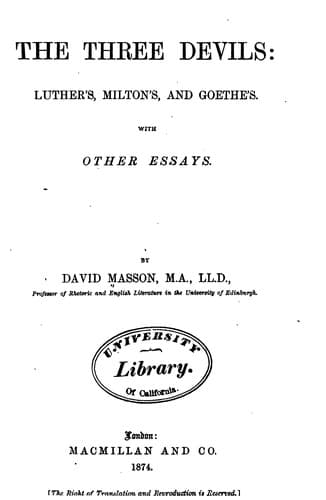
The Three Devils: Luther's, Milton's, and Goethe's; With Other EssaysMasson, David
History
The Three Devils: Luther's, Milton's, and Goethe's; With Other Essays
Masson, David
Devil in literature; Literature -- History and criticism
Shakespeare's genius we defined to be the genius of universal expression,
of clothing objects, circumstances, and feelings with magnificent
language, of pouring over the image of any given situation, whether
suggested from within or from without, an effusion of the richest
intellectual matter that could possibly be related to it. Goethe's genius,
as here defined by himself, was something different and narrower. It was
the genius of translation from the subjective into the objective, of
clothing real feelings with fictitious circumstance, of giving happy
intellectual form to states of mind, so as to dismiss and throw them off.
Let this distinction be sufficiently conceived and developed, and a full
idea will be obtained of the exact difference between the literary
many-sidedness attributed to Shakespeare and that also attributed to
Goethe.
MILTON'S YOUTH.
MILTON'S YOUTH.[5]
Never surely did a youth leave the academic halls of England more full of
fair promise than Milton, when, at the age of twenty-three, he quitted
Cambridge to reside at his father's house, amid the quiet beauties of a
rural neighbourhood some twenty miles distant from London. Fair in person,
with a clear fresh complexion, light brown hair which parted in the middle
and fell in locks to his shoulders, clear grey eyes, and a well-knit frame
of moderate proportions--there could not have been found a finer picture
of pure and ingenuous English youth. And that health and beauty which
distinguished his outward appearance, and the effect of which was
increased by a voice surpassingly sweet and musical, indicated with
perfect truth the qualities of the mind within. Seriousness, studiousness,
fondness for flowers and music, fondness also for manly exercises in the
open air, courage and resolution of character, combined with the most
maiden purity and innocence of life--these were the traits conspicuous in
Milton in his early years. Of his accomplishments it is hardly necessary
to take particular note. Whatever of learning, of science, or of
discipline in logic or philosophy, the University at that time could give,
he had duly and in the largest measure acquired. No better Greek or Latin
scholar probably had the University in that age sent forth; he was
proficient in the Hebrew tongue, and in all the other customary aids to a
Biblical Theology; and he could speak and write well in French and
Italian. His acquaintance, obtained by independent reading, with the
history and with the whole body of the literature of ancient and modern
nations, was extensive and various. And, as nature had endowed him in no
ordinary degree with that most exquisite of her gifts, the ear and the
passion for harmony, he had studied music as an art, and had taught
himself not only to sing in the society of others, but also to touch the
keys for his solitary pleasure.
Public-domain text, read in full here on John Shaqi.
Reviews
Reviews
No reviews yet
Be the first to share your thoughts on this work.
Elsewhere in the archive
Join the Discussion
Join the discussion
Sign in to leave a comment or review.
Sign InorCreate an account