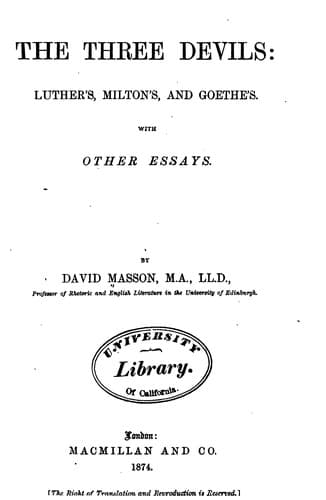
The Three Devils: Luther's, Milton's, and Goethe's; With Other EssaysMasson, David
History
The Three Devils: Luther's, Milton's, and Goethe's; With Other Essays
Masson, David
Devil in literature; Literature -- History and criticism
The instruments which Milton preferred as a musician were, his biographers
tell us, the organ and the bass-viol. This fact seems to us to be not
without its significance. Were we to define in one word our impression of
the prevailing tone, the characteristic mood and disposition of Milton's
mind, even in his early youth, we should say that it consisted in a deep
and habitual _seriousness_. We use the word in none of those special and
restricted senses that are sometimes given to it. We do not mean that
Milton, at the period of his early youth with which we are now concerned,
was, or accounted himself as being, a confessed member of that noble party
of English Puritans with which he afterwards became allied, and to which
he rendered such vast services. True, he himself tells us, in his account
of his education, that "care had ever been had of him, with his earliest
capacity, not to be negligently trained in the precepts of the Christian
religion;" and in the fact that his first tutor, selected for him by his
father, was one Thomas Young, a Scotchman of subsequent distinction among
the English Puritans, there is enough to prove that the formation of his
character in youth was aided expressly by Puritanical influences. But
Milton, if ever in a denominational sense he could be called a Puritan (he
wore his hair long, and in other respects did not conform to the usages of
the Puritan party), could hardly, with any propriety, be designated as a
Puritan in this sense, at the time when he left College. There is evidence
that at this time he had not given so much attention, on his own personal
account, to matters of religious doctrine as he afterwards bestowed. That
seriousness of which we speak was, therefore, rather a constitutional
seriousness, ratified and nourished by rational reflection, than the
assumed temper of a sect. "A certain reservedness of natural disposition,
and a moral discipline learnt out of the noblest philosophy"--such, in
Milton's own words, were the causes which, apart from his Christian
training, would have always kept him, as he believed, above the vices that
debase youth. And herein the example of Milton contradicts much that is
commonly advanced by way of a theory of the poetical character.
Public-domain text, read in full here on John Shaqi.
Reviews
Reviews
No reviews yet
Be the first to share your thoughts on this work.
Elsewhere in the archive
Join the Discussion
Join the discussion
Sign in to leave a comment or review.
Sign InorCreate an account