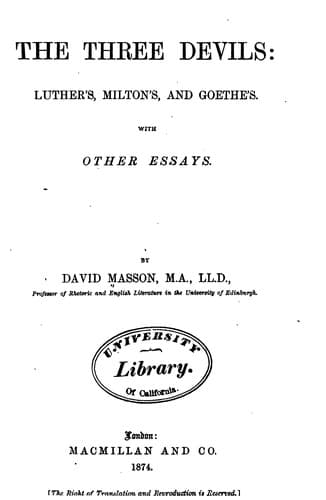
The Three Devils: Luther's, Milton's, and Goethe's; With Other EssaysMasson, David
History
The Three Devils: Luther's, Milton's, and Goethe's; With Other Essays
Masson, David
Devil in literature; Literature -- History and criticism
Poets and artists generally, it is held, are and ought to be distinguished
by a predominance of sensibility over principle, an excess of what
Coleridge called the spiritual over what he called the moral part of man.
A nature built on quicksands, an organization of nerve languid or
tempestuous with occasion, a soul falling and soaring, now subject to
ecstasies and now to remorses--such, it is supposed, and on no small
induction of actual instances, is the appropriate constitution of the
poet. Mobility, absolute and entire destitution of principle properly so
called, capacity for varying the mood indefinitely rather than for
retaining and keeping up one moral gesture or resolution through all
moods: this, say the theorists, is the essential thing in the structure of
the artist. Against the truth of this, however, as a maxim of universal
application, the character of Milton, as well as that of Wordsworth after
him, is a remarkable protest. Were it possible to place before the
theorists all the materials which exist for judging of Milton's personal
disposition as a young man, without exhibiting to them at the same time
the actual and early proofs of his poetical genius, their conclusion, were
they true to their theory, would necessarily be that the basis of his
nature was too solid and immovable, the platform of personal aims and
aspirations over which his thoughts moved and had footing too fixed and
firm, to permit that he should have been a poet. Nay, whosoever, even
appreciating Milton as a poet, shall come to the investigation of his
writings armed with that preconception of the poetical character which is
sure to be derived from an intimacy with the character of Shakespeare will
hardly escape some feeling of the same kind. Seriousness, we repeat, a
solemn and even austere demeanour of mind, was the characteristic of
Milton even in his youth. And the outward manifestation of this was a life
of pure and devout observance. This is a point that ought not to be
avoided, or dismissed in mere general language; for he who does not lay
stress on this knows not and loves not Milton. Accept, then, by way of
more particular statement, his own remarkable words in justifying himself
against an innuendo of one of his adversaries in later life, reflecting on
the tenor of his juvenile pursuits and behaviour. "A certain niceness of
nature," he says, "an honest haughtiness and self-esteem either of what I
was, or what I might be (which let envy call pride), and lastly that
modesty whereof, though not in the title-page, yet here I may be excused
to make some beseeming profession, all these, uniting the supply of their
natural aid together, kept me still above those low descents of mind
beneath which he must deject and plunge himself that can agree to saleable
and unlawful prostitutions." Fancy, ye to whom the moral frailty of genius
is a consolation, or to whom the association of virtue with youth and
Public-domain text, read in full here on John Shaqi.
Reviews
Reviews
No reviews yet
Be the first to share your thoughts on this work.
Elsewhere in the archive
Join the Discussion
Join the discussion
Sign in to leave a comment or review.
Sign InorCreate an account