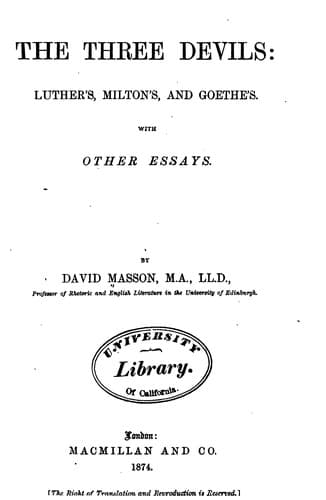
The Three Devils: Luther's, Milton's, and Goethe's; With Other EssaysMasson, David
History
The Three Devils: Luther's, Milton's, and Goethe's; With Other Essays
Masson, David
Devil in literature; Literature -- History and criticism
Cambridge is a jest--fancy Milton, as this passage from his own pen
describes him at the age of twenty-three, returning to his father's house
from the university, full of its accomplishments and its honours, an
auburn-haired youth, beautiful as the Apollo of a northern clime, and that
beautiful body the temple of a soul pure and unsoiled. Truly, a son for a
mother to take to her arms with joy and pride!
Connected with this austerity of character, discernible in Milton even in
his youth, may be noted also, as indeed it is noted in the passage just
cited, a haughty yet modest self-esteem and consciousness of his own
powers. Throughout all Milton's works there may be discerned a vein of
this noble egotism, this unbashful self-assertion. Frequently, in arguing
with an opponent, or in setting forth his own views on any subject of
discussion, he passes, by a very slight topical connexion, into an account
of himself, his education, his designs, and his relations to the matter in
question; and this sometimes so elaborately and at such length, that the
impression is as if he said to his readers, "Besides all my other
arguments, take this also as the chief and conclusive argument, that it is
_I_, a man of such and such antecedents, and with such and such powers to
perform far higher work than you see me now engaged in, who affirm and
maintain this." In his later years Milton evidently believed himself to
be, if not the greatest man in England, at least the greatest writer, and
one whose _egomet dixi_ was entitled to as much force in the intellectual
commonwealth as the decree of a civil magistrate is invested with in the
order of civil life. All that he said or wrote was backed in his own
consciousness by a sense of the independent importance of the fact that it
was he, Milton, who said or wrote it; and often, after arguing a point for
some time on a footing of ostensible equality with his readers, he seems
suddenly to stop, retire to the vantage-ground of his own thoughts, and
bid his readers follow him thither, if they would see the whole of that
authority which his words had failed to express.
Public-domain text, read in full here on John Shaqi.
Reviews
Reviews
No reviews yet
Be the first to share your thoughts on this work.
Elsewhere in the archive
Join the Discussion
Join the discussion
Sign in to leave a comment or review.
Sign InorCreate an account