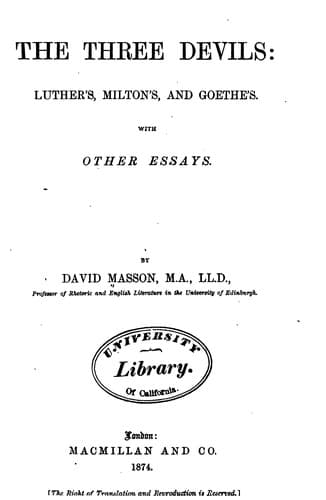
The Three Devils: Luther's, Milton's, and Goethe's; With Other EssaysMasson, David
History
The Three Devils: Luther's, Milton's, and Goethe's; With Other Essays
Masson, David
Devil in literature; Literature -- History and criticism
Nor is it merely as objects or phenomena that Milton sustains throughout
his whole poem a consistent conception of the Angels. He is likewise
consistent in his description of them as physical agents. Lofty stature
and appearance carry with them a promise of so much physical power; and
hence, in Milton's case, the necessity of finding words and figures
capable of expressing modes and powers of mechanical action, on the part
of the Angels, as superhuman as the stature and appearance he has given to
them. This complicated his difficulties very much. It is quite conceivable
that a man should be able to describe the mere appearance of a gigantic
being standing up, as it were, with his back to a wall, and yet utterly
break down, and not be able to find words, when he tried to describe this
gigantic being stepping forth into colossal activity and doing some
characteristic thing. Milton has overcome the difficulty. His conception
of the Angels as physical agents does not fall beneath his conception of
them as mere objects. In his description, for instance, in the sixth book,
of the Angels tearing up mountains by the roots and flinging them upon
each other, we have strength suggested corresponding to the reputed
stature of the beings. In extension of the same remark, we may observe how
skilfully Milton has aggrandized and eked out his conception of the
superhuman beings he is describing by endowing them with the power of
infinitely swift motion through space. On this point we offer our readers
an observation which they may verify for themselves:--Milton, we are
persuaded, had it vaguely in his mind, throughout _Paradise Lost_, that
the bounding peculiarity between the human condition of being and the
angelic one he is describing is the law of gravitation. We, and all that
is cognisable by us, are subject to this law; but Creation may be peopled
with beings who are not subject to it, and to us these beings are as if
they were not. But, whenever one of those beings becomes cognisable by us,
he instantly becomes subject to gravitation; and he must resume his own
mode of being ere he can be free from its consequences. The Angels were
not subject to gravitation; that is to say, they had the means of moving
in any direction at will. When they rebelled, and were punished by
expulsion from Heaven, they did not _fall_ out; for, in fact, so far as
the description intimates, there existed no planet, no distinct material
element, towards which they could gravitate. They were _driven_ out by a
pursuing fire. Then, after their fall, they had the power of rising
upward, of navigating space, of quitting Hell, directing their flight to
one glittering planet, alighting on its rotund surface, and then bounding
off again, and away to another. A corollary of this fundamental difference
between the human condition of being and the angelic would be that angels
are capable of direct vertical action, whereas men are capable mainly of
horizontal.
Public-domain text, read in full here on John Shaqi.
Reviews
Reviews
No reviews yet
Be the first to share your thoughts on this work.
Join the Discussion
Join the discussion
Sign in to leave a comment or review.
Sign InorCreate an account