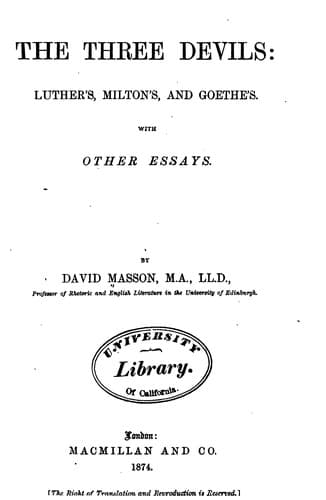
The Three Devils: Luther's, Milton's, and Goethe's; With Other Essays — John Shaqi
The Three Devils: Luther's, Milton's, and Goethe's; With Other EssaysMasson, David
History
The Three Devils: Luther's, Milton's, and Goethe's; With Other Essays
Masson, David
Devil in literature; Literature -- History and criticism
This is the difficulty with which Milton had to struggle; or, rather, this
is the difficulty with which he did not struggle. He had to construct a
narrative; and so, while he represents to us the full stature of his
superhuman beings as mere objects or phenomena, he does not attempt to
make events follow each other at a higher rate among those beings than
they do amongst ourselves, except in the single respect of their being
infinitely more powerful physical agents than we are. Whatever feeling of
inconsistency is experienced in reading the _Paradise Lost_ may be traced,
perhaps, to the fact that the necessities of the story obliged the poet
not to attempt to make the rate of causation among those beings as
extraordinary as his description of them as phenomena. Such a feeling of
inconsistency there is; and yet Milton sustains his flight as nobly as
mortal could have done. Throughout the whole poem we see him recollecting
his original conception of Satan as an object:--
"Thus Satan, talking to his nearest mate,
With head uplift above the waves, and eyes
That sparkling blazed; his other parts besides,
Prone on the flood, extended long and large,
Lay floating many a rood."
And this is a great thing to have done. If the poet ever flags in his
conception of those superhuman beings as objects, it is when he finds it
necessary to describe a multitude of them assembled together in some
_place_; and his usual device then is to reduce the bulk of the greatest
number. This, too, is for the behoof of the story. If it is necessary, for
instance, to assemble the Angels to deliberate, this must be done in an
audience-hall, and the human mind refuses to go beyond certain limits in
its conception of what an audience-hall is. Again the gate of Hell is
described, although the Hell of Milton is a mere vague extent of fiery
element, which, in strict keeping, could not be described as having a
gate. The narrative, however, requires the conception. And so in other
cases. Still, consistency of description is well sustained.
Public-domain text, read in full here on John Shaqi.
Reviews
Reviews
No reviews yet
Be the first to share your thoughts on this work.
Join the Discussion
Join the discussion
Sign in to leave a comment or review.
Sign InorCreate an account