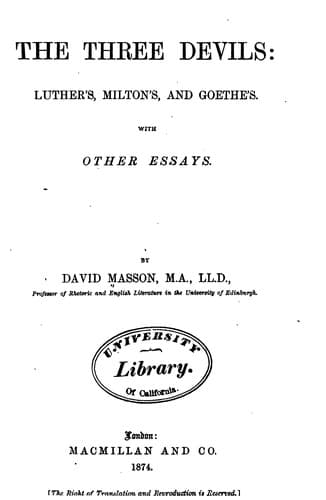
The Three Devils: Luther's, Milton's, and Goethe's; With Other EssaysMasson, David
History
The Three Devils: Luther's, Milton's, and Goethe's; With Other Essays
Masson, David
Devil in literature; Literature -- History and criticism
the fact that there might be legitimate manifestations of intellect of a
kind very different from his own. A Falstaff in real life, for example,
might have been to Milton the most unendurable of horrors, just as,
according to his own confession, a play-acting clergyman was his
abomination; and yet, in the pages of his honoured Shakespeare, Sir John
as mentor to the Prince, and Parson Hugh Evans as the Welch fairy among
the mummers, may have been creations he would con over and very dearly
appreciate. And this accounts for the multifarious and unrestricted
character of his literary studies. Milton, we believe, was a man whose
intellectual inquisitiveness and respect for talent would have led him, in
other instances than that of the College theatricals, to see and hear much
that his heart derided, to study and know what he would not strictly have
wished to imitate. Ovid and Tibullus, for example, contain much that is
far from Miltonic; and yet that he read poets of this class with
particular pleasure let the following quotation prove:--
"I had my time, readers, as others have who have good learning
bestowed upon them, to be sent to those places where, the opinion
was, it might be soonest attained; and, as the manner is, was not
unstudied in those authors which are most commended: whereof some
were grave orators and historians, whose matter methought I loved
indeed, but, as my age was, so I understood them; others were the
smooth elegiac poets whereof the schools are not scarce, whom, both
for the pleasing sound of their numerous writing (which, in
imitation, I found most easy, and most agreeable to nature's part in
me) and for their matter (which, what it is, there be few who know
not), I was so allured to read that no recreation came to me more
welcome--for, that it was then those years with me which are excused
though they be least severe I may be saved the labour to remember
ye."--_Apology for Smectymnuus._
That Milton, then, notwithstanding his natural austerity and seriousness
even in youth, was led by his keen appreciation of literary beauty and
finish, and especially by his delight in sweet and melodious verse, to
read and enjoy the poetry of those writers who are usually quoted as
examples of the lusciousness and sensuousness of the poetic nature, and
even to prefer them to all others, is specially stated by himself. But let
the reader, if he should think he sees in this a ground for suspecting
that we have assigned too much importance to Milton's personal seriousness
of disposition as a cause affecting his aims and art as a poet, distinctly
mark the continuation--
Public-domain text, read in full here on John Shaqi.
Reviews
Reviews
No reviews yet
Be the first to share your thoughts on this work.
Elsewhere in the archive
Join the Discussion
Join the discussion
Sign in to leave a comment or review.
Sign InorCreate an account