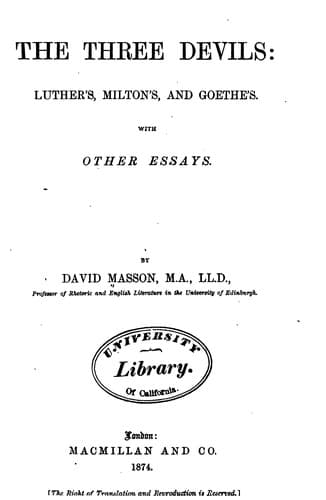
The Three Devils: Luther's, Milton's, and Goethe's; With Other EssaysMasson, David
History
The Three Devils: Luther's, Milton's, and Goethe's; With Other Essays
Masson, David
Devil in literature; Literature -- History and criticism
which we do in part attribute it, and are obliged to suppose that there
must have been, along with this, an actually finer substance and
condition, for the time being, of the national nerve. The very brain of
England must have become more "quick, nimble, and forgetive," before the
time of leisure came.
We have spoken of this great age of English literature as terminating with
the reign of James I., in 1625. In point of fact, however, it extended
some way into the reign of his son, Charles I. Spenser had died in 1599,
before James had ascended the English throne; Shakespeare and Beaumont had
died in 1616, while James still reigned; Fletcher died in 1625; Bacon
died in 1626, when the crown had been but a year on Charles's head. But,
while these great men and many of their contemporaries had vanished from
the scene before England had any experience of the first Charles, some of
their peers survived to tell what kind of men they had been. Ben Jonson
lived till 1637, and was poet-laureate to Charles I.; Donne and Drayton
lived till 1631; Herbert till 1632; Chapman till 1634; Dekker till 1638;
Ford till 1639; and Heywood and Massinger till 1640.
There is one point in the reign of Charles, however, where a clear line
may be drawn separating the last of the Elizabethan giants from their
literary successors. This is the point at which the Civil War commences.
The whole of the earlier part of Charles's reign was a preparation for
this war; but it cannot be said to have fairly begun till the meeting of
the Long Parliament in 1640, when Charles had been fifteen years on the
throne. If we select this year as the commencement of the great Puritan
and Republican Revolution in England, and the year 1660, when Charles II.
was restored, as the close of the same Revolution, we shall have a period
of twenty years to which, if there is any truth in the notion that the
Muses shun strife, this notion should be found peculiarly applicable. Is
it so? We think it is. In the first place, as we have just said, the last
of the Elizabethan giants died off before this period began, as if killed
by the mere approach to an atmosphere so lurid and tempestuous. In the
second place, in the case of such writers as were old enough to have
learnt in the school of those giants and yet young enough to survive them
and enter on the period of struggle,--as for example, Herrick (1591-1660),
Shirley (1596-1666), Waller (1605-1687), Davenant (1605-1668), Suckling
(1608-1643), Milton (1608-1674), Butler (1612-1680), Cleveland
(1613-1658), Denham (1615-1668), and Cowley (1618-1667),--it will be
found, on examination, either that the time of their literary activity did
not coincide with the period of struggle, but came before it, or after it,
or lay on both sides of it; or that what they did write of a purely
literary character during this period was written in exile; or, lastly,
that what they did write at home of a genuine literary character during
Public-domain text, read in full here on John Shaqi.
Reviews
Reviews
No reviews yet
Be the first to share your thoughts on this work.
Elsewhere in the archive
Join the Discussion
Join the discussion
Sign in to leave a comment or review.
Sign InorCreate an account