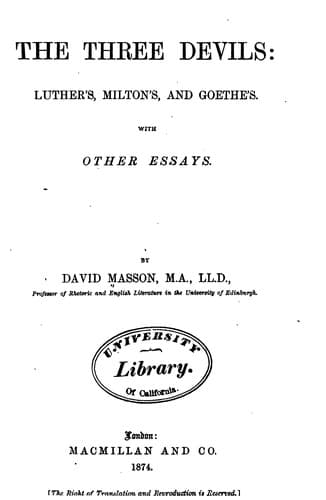
The Three Devils: Luther's, Milton's, and Goethe's; With Other EssaysMasson, David
History
The Three Devils: Luther's, Milton's, and Goethe's; With Other Essays
Masson, David
Devil in literature; Literature -- History and criticism
that was now in favour, however, was no longer the old English tragedy of
rich and complex materials, but the French tragedy of heroic declamation.
Familiarized by their stay in France with the tragic style of Corneille
and other dramatists of the court of Louis XIV., the Royalists brought
back the taste with them into England; and the poets who catered for them
hastened to abandon the Shakespearian tragedy, with its large range of
time and action and its blank verse, and to put on the stage tragedies of
sustained and decorous declamation in the heroic or rhymed couplet,
conceived, as much as possible, after the model of Corneille. Natural to
the French, this classic or regular style accorded ill with English
faculties and habits; and Corneille himself would have been horrified at
the slovenly and laborious attempts of the English in imitation of his
masterpieces. The effect of French influence at this time, however, on
English literary taste, did not consist merely in the introduction of the
heroic or rhymed drama. The same influence extended, and in some respects
beneficially, to all departments of English literature. It helped, for
example, to correct that peculiar style of so-called "wit" which,
originating with the dregs of the Elizabethan age, had during a whole
generation infected English prose and poetry, but more especially the
latter. The characteristic of the "metaphysical school of poetry," as it
is called, which took its rise in a literary vice perceptible even in the
great works of the Elizabethan age, and of which Donne and Cowley were the
most celebrated representatives, consisted in the identification of mere
intellectual subtlety with poetic genius. To spin out a fantastic conceit,
to pursue a thread of quaint thought as long as it could be held between
the fingers of the metre without snapping, and, in doing so, to wind it
about as many oddities of the real world as possible, and introduce as
many verbal quibbles as possible, was the aim of the "metaphysical poets."
Some of them, like Donne and Cowley, were men of independent merit; but
the style of poetry itself, as all modern readers confess by the alacrity
with which they avoid reprinted specimens of it, was as unprofitable an
investment of human ingenuity as ever was attempted. At the period of the
Restoration, and partly in consequence of French influence, this kind of
wit was falling into disrepute. There were still practitioners of it; but,
on the whole, a more direct, clear, and light manner of writing was coming
into fashion. Discourse became less stiff and pedantic; or, as Dryden
himself has expressed it, "the fire of English wit, which was before
stifled under a constrained melancholy way of breeding, began to display
its force by mixing the solidity of our nation with the air and gaiety of
our neighbours." And the change in discourse passed without difficulty
into literature, calling into being a nimbler style of wit, a more direct,
Public-domain text, read in full here on John Shaqi.
Reviews
Reviews
No reviews yet
Be the first to share your thoughts on this work.
Elsewhere in the archive
Join the Discussion
Join the discussion
Sign in to leave a comment or review.
Sign InorCreate an account