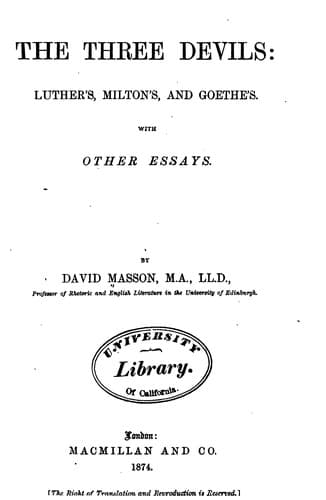
The Three Devils: Luther's, Milton's, and Goethe's; With Other EssaysMasson, David
History
The Three Devils: Luther's, Milton's, and Goethe's; With Other Essays
Masson, David
Devil in literature; Literature -- History and criticism
rapid, and decisive manner of thought and expression, than had beseemed
authorship before. In particular, and apart from the tendency to greater
directness and concision of thought, there was an increased attention to
correctness of expression. The younger literary men began to object to
what they called the involved and incorrect syntax of the writers of the
previous age, and to pretend to greater neatness and accuracy in the
construction of their sentences. It was at this time, for example, that
the rule of not ending a sentence with a preposition or other little word
began to be attended to. Whether the notion of correctness, implied in
this, and other such rules, was a true notion, and whether the writers of
the Restoration excelled their Elizabethan predecessors in this quality of
correctness, admits of being doubted. Certain it is, however, that a
change in the mechanism of writing--this change being on the whole towards
increased neatness--did become apparent about this time. The change was
visible in prose, but far more in verse. For, to conclude this enumeration
of the literary signs or tendencies of the age of the Restoration, it was
a firm belief of the writers of the period that then for the first time
was the art of correct English versification exemplified and appreciated.
It was, we say, a firm belief of the time, and indeed it has been a
common-place of criticism ever since, that Edmund Waller was the first
poet who wrote smooth and accurate verse, that in this he was followed by
Sir John Denham, and that these two men were reformers of English metre.
"Well-placing of words, for the sweetness of pronunciation, was not known
till Mr. Waller introduced it," is a deliberate statement of Dryden
himself, meant to apply especially to verse. Here, again, we have to
separate a matter of fact from a matter of doctrine. To aver, with such
specimens of older English verse before us as the works of Chaucer and
Spenser, and the minor poems of Milton, that it was Waller or any other
petty writer of the Restoration that first taught us sweetness, or
smoothness, or even correctness of verse, is so ridiculous that the
currency of such a notion can only be accounted for by the servility with
which small critics go on repeating whatever any one big critic has said.
That Waller and Denham, however, did set the example of something new in
the manner of English versification,--which "something" Dryden, Pope, and
other poets who afterwards adopted it, regarded as an improvement,--needs
not be doubted. For us it is sufficient in the meantime to recognise the
change as an attempt after greater neatness of mechanical structure,
leaving open the question whether it was a change for the better.
Public-domain text, read in full here on John Shaqi.
Reviews
Reviews
No reviews yet
Be the first to share your thoughts on this work.
Elsewhere in the archive
Join the Discussion
Join the discussion
Sign in to leave a comment or review.
Sign InorCreate an account