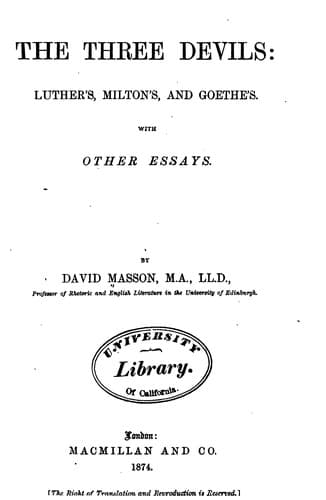
The Three Devils: Luther's, Milton's, and Goethe's; With Other EssaysMasson, David
History
The Three Devils: Luther's, Milton's, and Goethe's; With Other Essays
Masson, David
Devil in literature; Literature -- History and criticism
It was natural that the tendencies of English literature thus enumerated
should be represented in the poet-laureate for the time being. Who was the
fit man to be appointed laureate at the Restoration? Milton was out of the
question, having none of the requisites. Butler, the man of greatest
natural power of a different order, and possessing certainly as much of
the anti-Puritan sentiment as Charles and his courtiers could have desired
in their laureate, was not yet sufficiently known, and was, besides,
neither a dramatist nor a fine gentleman. Cowley, whom public opinion
would have pointed out as best entitled to the honour, was somehow not in
much favour at court, and was spending the remainder of his days on a
little property near Chertsey. Waller and Denham were wealthy men, with
whom literature was but an amusement. On the whole, Sir William Davenant
was felt to be the proper man for the office. He was an approved royalist;
he had, in fact, been laureate to Charles I. after Ben Jonson's death in
1637; and he had suffered much in the cause of the king. He was, moreover,
a literary man by profession. He had been an actor and a theatre-manager
before the Commonwealth; he had been the first to start a theatre after
the relaxed rule of Cromwell made it possible; and he was one of the first
to attempt heroic or rhymed tragedies after the French model. He was also,
far more than Cowley, a wit of the new school; and, as a versifier, he
practised, with no small reputation, the neat, lucid style introduced by
Denham and Waller. He was the author of an epic called _Gondibert_,
written in rhymed stanzas of four lines each, which Hobbes praised as
showing "more shape of art, health of morality, and vigour and beauty of
expression," than any poem he had ever read. We defy anyone to read the
poem now; but there have been worse things written; and it has the merit
of being a careful and rather serious composition by a man who had
industry, education, and taste, without genius. There was but one
awkwardness in having such a man for laureate: he had no nose. This
awkwardness, however, had existed at the time of his first appointment in
the preceding reign. At least, Suckling adverts to it in the _Session of
the Poets_, where he makes the wits of that time contend for the bays--
"Will Davenant, ashamed of a foolish mischance,
That he had got lately, travelling in France,
Modestly hoped the handsomeness of 's muse
Might any deformity about him excuse.
"And surely the company would have been content,
If they could have found any precedent;
But in all their records, either in verse or prose,
There was not one laureate without a nose."
Public-domain text, read in full here on John Shaqi.
Reviews
Reviews
No reviews yet
Be the first to share your thoughts on this work.
Elsewhere in the archive
Join the Discussion
Join the discussion
Sign in to leave a comment or review.
Sign InorCreate an account