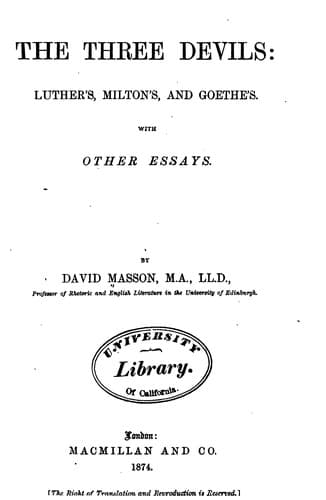
The Three Devils: Luther's, Milton's, and Goethe's; With Other EssaysMasson, David
History
The Three Devils: Luther's, Milton's, and Goethe's; With Other Essays
Masson, David
Devil in literature; Literature -- History and criticism
If the more decorous court of Charles I., however, overlooked this
deficiency, it was not for that of Charles II. to take objection to it.
After all, Davenant, notwithstanding his misfortune, seems to have been
not the worst gentleman about Charles's court, either in morals or
manners. Milton is said to have known and liked him.
Davenant's laureateship extended over the first eight years of the
Restoration, or from 1660 to 1668. Much was done in those eight years both
by himself and others. Heroic plays and comedies were produced in
sufficient abundance to supply the two chief theatres then open in
London--one of them that of the Duke's company, under Davenant's
management; the other, that of the King's company, under the management
of an actor named Killigrew. The number of writers for the stage was very
great, including not only those whose names have been mentioned, but
others new to fame. The literature of the stage formed by far the largest
proportion of what was written, or even of what was published. Literary
efforts of other kinds, however, were not wanting. Of satires, and small
poems in the witty or amatory style, there was no end. The publication by
Butler of the first part of his _Hudibras_ in 1663, and of the second in
1664, drew public attention, for the first time, to a man, already past
his fiftieth year, who had more true wit in him than all the aristocratic
poets put together. The poem was received by the king and the courtiers
with shouts of laughter; quotations from it were in everybody's mouth;
but, notwithstanding large promises, nothing substantial was done for the
author. Meanwhile Milton, blind and gouty, and living in his house near
Bunhill Fields, where his visitors were hardly of the kind that admired
Butler's poem, was calmly proceeding with his _Paradise Lost_. The poem
was finished and published in 1667, leaving Milton free for other work.
Cowley, who would have welcomed such a poem, and whose praise Milton would
have valued more than that of any other contemporary, died in the year of
its publication. Davenant may have read it before his death in the
following year; but perhaps the only poet of the time who hailed its
appearance with enthusiasm adequate to the occasion was Milton's personal
friend Marvell. Gradually, however, copies of the poem found their way
about town, and drew public attention once more to Cromwell's old
secretary.
Public-domain text, read in full here on John Shaqi.
Reviews
Reviews
No reviews yet
Be the first to share your thoughts on this work.
Elsewhere in the archive
Join the Discussion
Join the discussion
Sign in to leave a comment or review.
Sign InorCreate an account