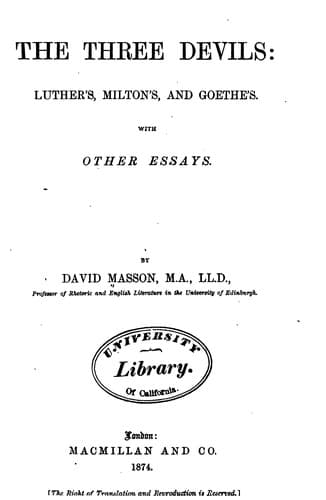
The Three Devils: Luther's, Milton's, and Goethe's; With Other EssaysMasson, David
History
The Three Devils: Luther's, Milton's, and Goethe's; With Other Essays
Masson, David
Devil in literature; Literature -- History and criticism
The laureateship remained vacant two years after Davenant's death; and
then it was conferred--on whom? There can be little doubt that, of those
eligible to it, Butler had, in some respects, the best title. The author
of _Hudibras_, however, seems to have been one of those ill-conditioned
men whom patronage never comes near, and who are left, by a kind of
necessity, to the bitter enjoyment of their own humours. There does not
seem to have been even a question of appointing him; and the office, the
income of which would have been a competence to him, was conferred on a
man twenty years his junior, and whose circumstances required it
less--John Dryden. The appointment, which was made in August, 1670,
conferred on Dryden not only the laureateship, but also the office of
"historiographer royal," which chanced to be vacant at the same time. The
income accruing from the two offices thus conjoined was 200_l._ a-year,
which was about as valuable then as 600_l._ a-year would be now; and it
was expressly stated in the deed of appointment that these emoluments were
conferred on Dryden "in consideration of his many acceptable services done
to his majesty, and from an observation of his learning and eminent
abilities, and his great skill and elegant style both in verse and prose."
At the time of the Restoration, or even for a year or two after it, such
language could, by no stretch of courtesy, have been applied to Dryden. At
that time, as we have seen, though already past his thirtieth year, he was
certainly about the least distinguished person in the little band of wits
that were looking forward to the good time coming. He was a stout,
fresh-complexioned man, in grey drugget, who had written some robust
stanzas on Cromwell's death, and a short poem, also robust, but rather
wooden, on Charles's return. That was about all that was then known about
him. What had he done, in the interval, to raise him so high, and to make
it natural for the Court to prefer him to what was in fact the titular
supremacy of English literature, over the heads of others who might be
supposed to have claims, and especially over poor battered old Butler? A
glance at Dryden's life during Davenant's laureateship, or between 1660
and 1670, will answer this question.
Public-domain text, read in full here on John Shaqi.
Reviews
Reviews
No reviews yet
Be the first to share your thoughts on this work.
Elsewhere in the archive
Join the Discussion
Join the discussion
Sign in to leave a comment or review.
Sign InorCreate an account