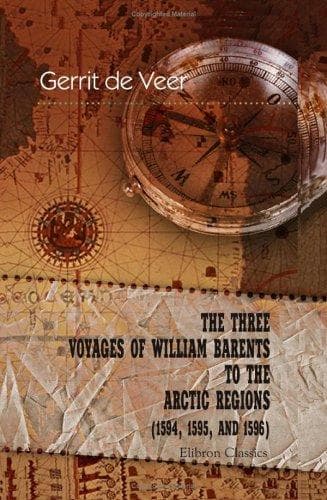
The Three Voyages of William Barents to the Arctic Regions (1594, 1595, and 1596)Veer, Gerrit de
History
The Three Voyages of William Barents to the Arctic Regions (1594, 1595, and 1596)
Veer, Gerrit de
Barentsz, Willem, approximately 1550-1597; Northeast Passage
Of these expeditions, the first was that of Stephen Burrough, who had
in 1553 been the master of Richard Chancellor’s ship, the Edward
Bonaventure, and who now, in 1556, was despatched in the pinnace
Searchthrift to make discovery towards the river Ob. [35]
Leaving Gravesend on the 23rd of April of the latter year, Burrough, on
the 23rd of May, passed the North Cape, which he had so named on his
first voyage, and on the 9th of June reached Kola, where he fell in
with several small Russian vessels (lodji), all “bound to Pechora, a
fishing for salmons and morses”. [36] The master of one of these boats,
named Gabriel, rendered good service to Burrough, who is diffuse in his
praise of Gabriel’s conduct, as contrasted with that of other Russian
seamen with whom he had to do.
In the company of these native boats Burrough passed by Svyátoi Nos,
called by him Cape St. John; Kanin Nos (Caninoz); the island of
Kolguev, by mistake called in his journal Dolgoieue; then the second
Svyátoi Nos, and so to “the dangerous barre of Pechora”. Passing still
onwards, he, on St. James’s day, July 25th, “spied certain islands”,
lying to the south of Novaya Zemlya, under one of which he anchored,
naming it “St. James his Island”, [37] and making its latitude to be
70° 42′ N., which according to Lütke [38] is about 10′ too far north.
The next day they “plyed to the westwards alongst the shoare” of the
southern extremity of Novaya Zemlya, where they met with another small
native vessel, the master of which, named Loshak, told them that they
were past the way which should bring them to the Ob;—that the land by
which they were was “called Noua Zembla, that is to say, the New
Land;”—and that “in this Noua Zembla is the highest mountaine in the
worlde, as he thought, and that Camen Bolshay, [39] which is on the
maine of Pechora, is not to be compared to this mountaine; but” (adds
Burrough cautiously) “I saw it not”. [40]
On the 31st of July, Burrough was “at an anker among the islands of
Vaigats”; on one of which islands he went on shore the following day.
On Monday, the 3rd of August, he continues: “We weyed and went roome
with another island, which was five leagues east-north-east from us;
and there I met againe with Loshak, and went on shore with him, and hee
brought me to a heap of the Samoeds idols, which were in number aboue
300, the worst and the most unartificiall worke that ever I saw. The
eyes and mouthes of sundrie of them were bloodie; they had the shape of
men, women, and children, very grosly wrought; and that which they had
made for other parts was also sprinckled with blood. Some of their
idols were an olde sticke, with two or three notches made with a knife
in it. I saw much of the footing of the sayd Samoeds, and of the sleds
that they ride in.” [41]
Public-domain text, read in full here on John Shaqi.
Reviews
Reviews
No reviews yet
Be the first to share your thoughts on this work.
Elsewhere in the archive
Join the Discussion
Join the discussion
Sign in to leave a comment or review.
Sign InorCreate an account