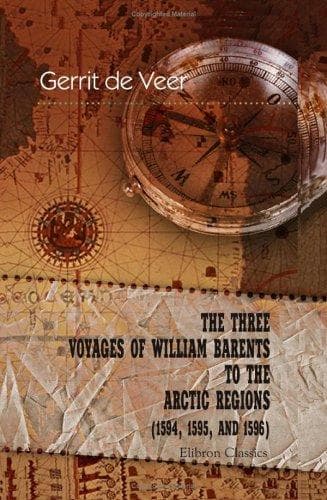
The Three Voyages of William Barents to the Arctic Regions (1594, 1595, and 1596)Veer, Gerrit de
History
The Three Voyages of William Barents to the Arctic Regions (1594, 1595, and 1596)
Veer, Gerrit de
Barentsz, Willem, approximately 1550-1597; Northeast Passage
Several voyages had been made by Englishmen, mentioned in Dr. Beke’s
introduction, towards the north-east, concerning which every particular
was known in the Netherlands. This has since been proved by an
irrefutable fact; for the so-called journals of Barendsz, which were in
1875 brought back to Norway, turned out to be a Dutch translation of
the journals of the English navigators, Pet and Jackman, who, in 1580,
endeavoured to find the north-east passage. This translation was found
in the old wintering house of Barendsz in Novaya Zemlya, and
consequently he must have taken it with him on his last voyage. There
can, therefore, be no doubt that the Netherlanders had watched eagerly,
and with intense interest, the attempts made by the English to find the
north-east passage to the Indies. This may be the reason why a few
Netherlanders tried at first to penetrate over-land in that direction,
for a certain Olivier Brunel succeeded in reaching as far as the Obi
river, travelling all the way on terra firma. Thanks to the industrious
and intelligent researches of the historian of “De Noordsche
Compagnie”, Mr. S. Muller, Fz., we now know a great deal more of this
Olivier Brunel than Dr. Beke did in 1853.
The history of Brunel has especially roused Mr. Muller’s interest, and
the facts discovered during his researches are so surprising that we
think we cannot do better than give them nearly verbatim.
At the time that the English settled themselves at the mouth of the
Dwina river, in the neighbourhood of the monastery of St. Nicholas,
they had spared no trouble to maintain themselves continually in the
exclusive possession of the trade in these regions. In this they
succeeded but for a short period.
Twelve years after their arrival on the shores of the White Sea, the
Dutch had found, at least partially, the track of their predecessors.
In the year 1565, a certain Philip Winterköning, an exile from
Wardöhuis, entered upon a negotiation with the Netherlanders. By his
intervention a ship was sent out from Enkhuizen, and arrived at a spot,
where a settlement was soon formed, to which they gave the name of
Kola.
In the following year, 1566, two merchants of Antwerp, Simon van
Salingen and Cornelis de Meyer, steering from Kola along the coast,
ventured to follow in the track of the English to the White Sea. They
landed at the mouth of the Onega, and travelled, disguised as Russians,
overland to Moscow. This courageous voyage was undertaken for no other
object than to settle private affairs; and they did not avail
themselves of the opportunity that thus occurred of establishing
commercial relations with the White Sea.
Public-domain text, read in full here on John Shaqi.
Reviews
Reviews
No reviews yet
Be the first to share your thoughts on this work.
Join the Discussion
Join the discussion
Sign in to leave a comment or review.
Sign InorCreate an account