LAYMAN,
310 Ashland Boulevard.
Chicago, July 29, 1903.
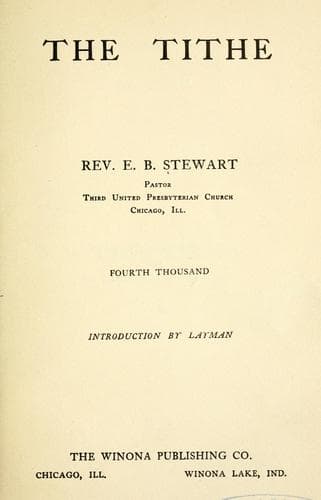
THE TITHE.
ITEMS OF HISTORY.
“Tithe” is an Anglo-Saxon word meaning “the tenth.” Technically
speaking, it is defined as “the tenth of produce, property or spoils
dedicated to sacred use.” Trench quotes with approval Emerson’s
characterization of language as “fossil poetry” and adds, “but it may
be affirmed of it with exactly the same truth that it is fossil ethics
or fossil history. Words quite as often and as effectually embody parts
of history, or convictions of the moral sense, as of the imagination
or passion of men.” While this is true of words in such a fascinating
way, it will, no doubt, furnish the best basis of conclusion, to trace
the history of this word and the principle which it involves. If a word
embodies history, the history of a word may contain much information
of value. This word then will briefly be traced in both Biblical and
Extra-Biblical History.
FIRST: In Biblical Record it appears early. Its _first_ distinct
mention is in Gen. 14:20. Abram returning from the slaughter of the
four kings was met by Melchizedek, king of Salem, and priest of the
most high God. He blessed Abram, who in turn recognized him as his
priest before God, and “gave him tithes of all” the spoil.
Its _second_ is in Gen. 28:22. Jacob had been to the gate of heaven,
and none other than Bethel could be chosen as a name for that place.
Here Jacob under the impression of the awe of God’s presence, vowed a
vow, saying, “If God will be with me, and will keep me in this way that
I go, and will give me bread to eat, and raiment to put on, so that I
come again to my father’s house in peace; then shall the Lord be my
God; and this stone which I have set up for a pillar, shall be God’s
house; and of all that thou shalt give me I will surely give the tenth
unto thee.”
The _third_ use is in connection with the Levitical law. The Lord spake
through Moses and gave this commandment, which is most fully stated in
the three following places:
First: Lev. 27:30-32: “And all the tithe of the land, whether of the
seed of the land or of the fruit of the tree, is the Lord’s: it is holy
unto the Lord. And if a man will at all redeem ought of his tithes he
shall add thereto the fifth part thereof. And concerning the tithe of
the herd or of the flock, even of whatsoever passeth under the rod, the
tenth shall be holy unto the Lord.”
Public-domain text, read in full here on John Shaqi.
Reviews
Reviews
No reviews yet
Be the first to share your thoughts on this work.
Join the Discussion
Join the discussion
Sign in to leave a comment or review.
Sign InorCreate an account