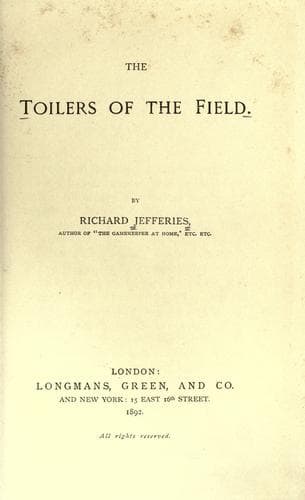
Agricultural laborers -- England; Country life -- England
Over these offices was the
cheese-room. This was and still is a long, large, and lofty room in
which the cheese after being made is taken to dry and harden. It is
furnished with a number of shelves upon which the cheeses are arranged,
and as no two can be placed one on the other in the early stage of their
maturing, much space is required. It is the duty of the dairymaid and
her assistant to turn these cheeses every morning--a work requiring some
strength. In this part of the house are the servants' rooms. In front of
the dairy and brewhouse is a paved court enclosed with a wall, and in
this court it was not uncommon to find a well, or hog-tub, for the
refuse of the dairy. Sometimes, but not often now, the pig-stye is just
outside the wall which surrounds the court. In this court, too, the
butter is generally churned, under a "skilling" which covers half of it.
Here also the buckets are washed, and other similar duties performed.
The labourers come here to receive their daily allowance of beer.
Most farmhouses in large arable farms were originally built so as to
have a small dairy at the back; though there was a time when the arable
farmer never thought of keeping a cow, and butter and cheese were
unknown, except as luxuries, in his establishment. This was during the
continuance of the Corn Laws, when everything was sacrificed to the one
great object of growing wheat. It was not impossible in those days to
find a whole parish (I know of one myself) in which there was not a
single cow. Now the great object is meat, then it was corn. But at the
time when most of the farmhouses were erected, the system of agriculture
pursued was a judicious mixture of the dairy and the cornfield, so that
very few old farmhouses exist which have not some form of dairy
attached. In the corn-growing times, most of the verdant meadows now
employed to graze cattle, or for producing hay, were ploughed up. This
may be seen by the regular furrows, unmistakable evidences of the
plough. When corn declined in price through the influx of foreign
produce, the land was again laid down in grass, and most of it continues
so till this hour. It might be roughly estimated that England now
contains a third more meadow land than in the early part of the present
century, notwithstanding the attempt to plough up the downs.
Public-domain text, read in full here on John Shaqi.
Reviews
Reviews
No reviews yet
Be the first to share your thoughts on this work.
Join the Discussion
Join the discussion
Sign in to leave a comment or review.
Sign InorCreate an account