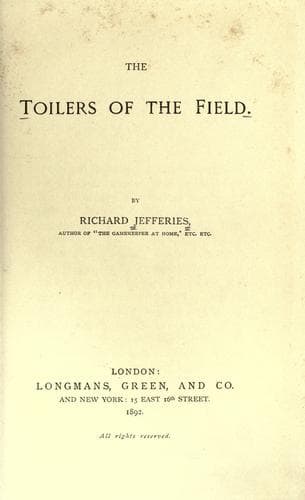
Agricultural laborers -- England; Country life -- England
We now come to the third class of farmsteads--low thatched buildings,
little better than large cottages, and indeed frequently converted into
dwellings for labourers. These are generally found on small farms, and
in districts where there are a number of small landed proprietors. These
freeholders built houses according to their means. In process of time
they were bought up by the great landowners, and the farms thrown
together, when the houses were used for other purposes. Some may still
be found, especially in dairy districts. In these the principal part of
the house is usually the dairy, which absorbs at least half of the
ground floor, and opens on the kitchen, in which the family sit, and in
which their food is often cooked. The eaves of the house are low, and
there are scarcely any appliances for comfort. The yeomen who originally
lived in these places in all respects resembled the labourers with whom
they ate and drank and held the most familiar intercourse. Their
labourers even slept in the same bedrooms as the family. But these men,
though they mingled so freely with the labourer, were his worst enemy.
The little profit they made was entirely accumulated by careful economy.
They were avaricious and penurious to the last degree, and grudged every
halfpenny to the labouring man. They were, and the remnant of them still
are, the determined opponent of all progress. The interior of some of
these cottage-farmsteads, which still exist, is almost Dutch-like in
simplicity and homeliness. The fireplace is of a vast size, fitted with
antique iron dogs for burning wood, and on it swing the irons to sustain
the great pot. On each side, right under the chimney, are seats, the
ingle-nook of olden times. The chimney itself is very large, being
specially built for the purpose of curing sides of bacon by smoking. The
chimneypiece is ornamented with a few odd figures in crockery-ware,
half-a-dozen old brass candlesticks, and perhaps a snuff-box or tobacco
dish. The floor is composed of stone flags--apt to get slimy and damp
when the weather is about to change--and the wide chinks between them
are filled with hardened dirt. In the centre there is a piece of carpet
on which the table stands, but the rest of the room is bare of
carpeting, except the hearth-rug. The low window has a seat let into the
wall under it. The furniture of the apartment is utilitarian in the
strictest sense. There is nothing there for ornament or luxury, or even
for ease; only what is absolutely necessary. Generally there is a
dresser, above which, on shelves, the dishes and plates are arranged. A
tall upright eight-day clock, with a brazen face, and an inscription
which tells that it was manufactured in a neighbouring village, stands
in one corner, and solemnly ticks in its coffin-like panelled case. On
each side of the fireplace there is an arm-chair, often cushioned with
a fox or badger skin, and a great brazen warming-pan hangs near the
door.
Public-domain text, read in full here on John Shaqi.
Reviews
Reviews
No reviews yet
Be the first to share your thoughts on this work.
Join the Discussion
Join the discussion
Sign in to leave a comment or review.
Sign InorCreate an account