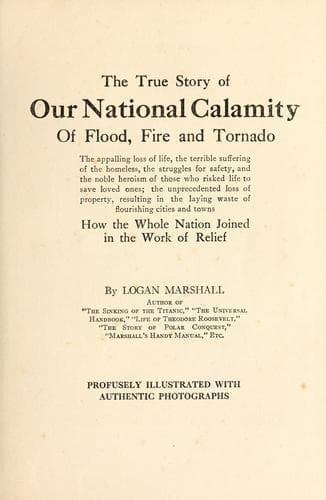
The True Story of Our National Calamity of Flood, Fire and TornadoMarshall, Logan
History
The True Story of Our National Calamity of Flood, Fire and Tornado
Marshall, Logan
Floods -- Ohio River Valley; Omaha (Neb.) -- Tornado, 1913
Most of the business houses and nearly all residences had occupants.
Downtown the offices were filled with men, fathers unable to get home,
and the upper floors and on some of the roofs of the residences were
helpless women and children. Hundreds of houses, substantial buildings
in the residence districts, many of them with helpless occupants, were
washed away.
The water in the Miami River began rising Monday afternoon at the rate
of six inches an hour and continued to rise throughout the night. The
first break in the levee at Dayton came at four o'clock Tuesday morning
at Stratford Avenue. This was followed by other breaks at East Second
Street and Fifth.
THE RESERVOIR BREAKS
But the severity of the flood that hit Dayton was due to the collapse of
the Loramie reservoir in Shelby County about seven o'clock on Tuesday
morning, hurling millions of gallons of water into the swollen Miami.
Rushing down the Miami Valley, the water carried everything before it
at Piqua, Troy, Sidney, Dayton, Carrollton, Miamisburg and Hamilton.
Three rivers, the Miami, Stillwater and Mad, and Wolf Creek conjoin in
the heart of Dayton. As the city, particularly North Dayton, and a north
section called Riverside, lies almost on a level with the four streams,
it is protected from high water by levees twenty-five feet high, which
guide the streams through the city from its northern to its southern
end.
[Illustration: NORTHERN PART OF DAYTON, AND WATER COURSES WHICH
OVERWHELMED THE CITY]
North Dayton is a manufacturing and residence district. Riverdale is a
residence district. In the southern part of the city, on fairly high
ground, is the great plant of the National Cash Register Company
Wolf Creek, flowing into the Miami from the northwest, early got out of
its banks and added to the flood flowing over the floors of the Williams
Street and Edgewater Avenue bridges.
Mad River, in the northern section, also got over its banks early. All
of North Dayton, save the extreme uplands, was inundated. The Miami was
more than a mile wide below the city, and thousands of acres were
inundated.
BUSINESS SECTION FLOODED
At Third and Ludlow Streets, where were located the great Algonquin
Hotel, a magnificent church, the great Y. M. C. A. building and the
Hotel Atlas, were many feet of water. The central portion of the city
was flooded, and the beautiful residence district, lying east of the
exclusive boulevard district, was a Venice.
Hundreds of homes were filled with floating furniture. The citizens,
used to the slow-creeping floods of other years, were entirely mystified
and distracted by this sudden, hurtling, seething flood that seemed to
spring by night from the clouds that hovered low over the city and
plunged their seas of water into the rivers that converge in the very
heart of Dayton.
Public-domain text, read in full here on John Shaqi.
Reviews
Reviews
No reviews yet
Be the first to share your thoughts on this work.
Join the Discussion
Join the discussion
Sign in to leave a comment or review.
Sign InorCreate an account