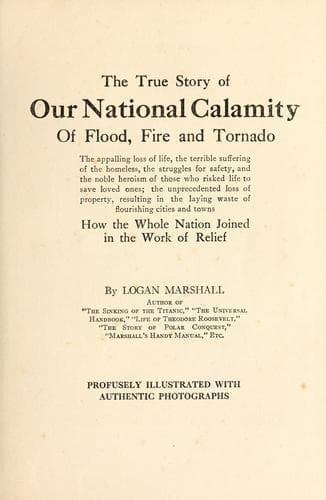
The True Story of Our National Calamity of Flood, Fire and TornadoMarshall, Logan
History
The True Story of Our National Calamity of Flood, Fire and Tornado
Marshall, Logan
Floods -- Ohio River Valley; Omaha (Neb.) -- Tornado, 1913
Railroad and wagon bridges over the Miami River were swept away. The
telephone operator at Phoneton said that from his window in the station
he had seen a bridge one mile north of Dayton collapse and another
bridge crossing the river at Tadmor, eleven miles north of Dayton, was
expected to give way at any moment.
Communication between Phoneton and Dayton, the operator said, was only
intermittent, as the only available wire was being used by the linemen
in their efforts to restore service.
Troy and Tippecanoe City, north of Dayton, were both flooded and many
people took refuge on the roofs of their homes.
Below Dayton vast acreages were seas of yellow. Farms were lakes, roads
were raceways through which raced the swollen streams. Telegraph service
was maimed, and all sorts of communication was well-nigh impossible.
THOUSANDS MAROONED
Crowded in the upper stories of tall office buildings and residences,
two miles each way from the center of the town, were thousands of
persons whom it was impossible to approach. At Wyoming Street, three
miles beyond what has heretofore been considered the danger line, water
was running eight feet deep.
The Western Union operator at Dodson, Ohio, said the office was filled
with foreigners who had fled from Dayton. Looters were shooting people
down in the streets, according to these refugees. They also reported
that the Fifth Street bridge at Dayton had washed down against the
railroad bridge and arrangements were being made to dynamite both
structures. This bridge was dynamited in the afternoon, but the effect
was not felt to any marked degree.
The foreigners who sought refuge in the Dodson telegraph office were
panic-stricken and told wild stories of the flood, saying nearly every
part of the town was under water and the conditions becoming more
serious.
The breaking of the Tarleton reservoir, which supplies the drinking
water, left the city without water and added great danger of typhoid in
the use of flood water.
Frank Purviance, an employee of the Terre Haute, Indianapolis and
Eastern Traction Company, at Dayton, over the long-distance telephone
said scores had been drowned there.
"They're dying like rats in their homes; bodies are washing around the
streets and there's no relief in sight," Purviance said.
MANY CREEP TO SAFETY BY CABLE
At Wyoming Station, on the South Side, where the National Cash Register
Company centered its efforts at rescue, many saved their lives by
creeping on a telephone cable, a hundred feet above the flood.
At first linemen crept along the cables, carrying tow ropes to which
flat-bottomed boats were attached. When the flood became so fierce that
the boats no longer were able to make way against it, men and women
crept along the cables to safety. Others, less daring, saw darkness fall
and gave up hope of rescue.
Those willing to risk their lives in the attempt to rescue found
themselves helpless in the face of the water.
Public-domain text, read in full here on John Shaqi.
Reviews
Reviews
No reviews yet
Be the first to share your thoughts on this work.
Join the Discussion
Join the discussion
Sign in to leave a comment or review.
Sign InorCreate an account