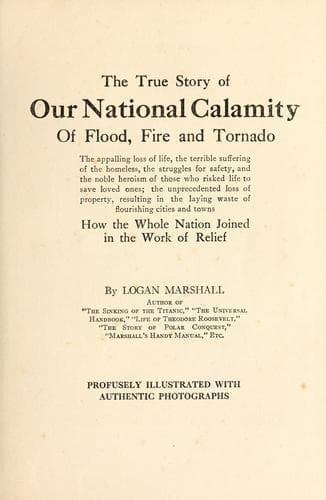
The True Story of Our National Calamity of Flood, Fire and TornadoMarshall, Logan
History
The True Story of Our National Calamity of Flood, Fire and Tornado
Marshall, Logan
Floods -- Ohio River Valley; Omaha (Neb.) -- Tornado, 1913
EMPLOYEES ASSIST IN RELIEF
The Cash Register plant is outside the flood zone. As soon as the waters
rushed upon the city John Henry Patterson turned his entire force into a
relief organization. Every wheel was stopped in the Cash Register plant
early on Tuesday morning and the employees were set to work by Mr.
Patterson to help the sufferers.
Mr. Patterson bought up all the available food and had it carted to his
plant to feed the homeless. Straw was quickly strewn on the factory
floors, thus affording dry sleeping places for more than one thousand at
night. Every employee of the corporation capable of working on boats was
put to work at boat building.
Mr. Patterson is said to have made a promise long ago to his wife, who
was Katherine Beck, a school teacher of Brookline, Mass., when she was
dying, that he would give special care to the comfort and welfare of his
women and girl employees. The dining rooms in the big plant, the rest
and recreation rooms and other architectural comforts provided for the
women employees as a result of this promise came in very well in the
rescue work. The dining rooms and the rest and recreation rooms all were
used as eating halls in helping the sufferers.
While Mr. Patterson was out pulling at the oars of one of his boats
thirty-one of his company's automobiles were meeting the craft to hurry
the refugees to the Cash Register plant and to dry clothing, food and
beds.
Mr. Patterson sent out an appeal for immediate food supplies and for
doctors and medicine. By night three thousand homeless were housed in
improvised quarters in the Cash Register offices.
GIRL IN MAN'S CLOTHING
"What is your name?" asked the registrars who received the refugees at
the National Cash Register plant of a slender young person in men's
clothes.
"Nora Thuma," was the reply.
"Nora?" they asked.
"Yes, I'm a girl," was the answer.
She had put on a man's suit in order to cross the perilous span of wires
unhampered by skirts.
She came in with Ralph Myers, his wife and their little baby. Myers had
climbed a telephone wire pole first. He let down a rope to his wife, who
tied to it a meal sack which contained their baby, three months old.
Myers pulled the rope with its precious burden up and then let it down
again to aid his wife to ascend from her perilous position.
With the meal sack over his shoulder and his wife holding on to the two
wires he walked along the cable a full block before he reached safety.
[Illustration: Copyright by Underwood & Underwood.
A typical scene on the outskirts of Dayton. Here scores of houses were
completely washed from their foundations and many of the inhabitants
were drowned]
[Illustration: Copyright by the International News Service.
A view taken at Ludlow and Second Streets, Dayton, after the water had
receded, showing one phase of the devastation resulting from the flood]
SCENES OF HORROR
Public-domain text, read in full here on John Shaqi.
Reviews
Reviews
No reviews yet
Be the first to share your thoughts on this work.
Join the Discussion
Join the discussion
Sign in to leave a comment or review.
Sign InorCreate an account