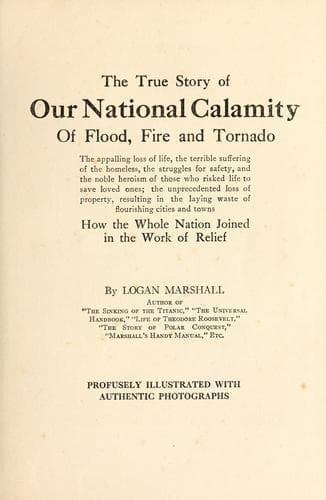
The True Story of Our National Calamity of Flood, Fire and TornadoMarshall, Logan
History
The True Story of Our National Calamity of Flood, Fire and Tornado
Marshall, Logan
Floods -- Ohio River Valley; Omaha (Neb.) -- Tornado, 1913
The first to seek safety by sliding along the telegraph conduits was a
man. Then came four women. The first of the women was Mrs. Luella Meyer.
She was a widow with one son, a boy in knee-breeches.
He got out on the wire and with the agility of a cat was soon across.
But Mrs. Meyers, when over the boiling torrent, swayed as though faint,
slipped and the crowd stood with bated breath.
By a lucky chance her senses came back to her so that she could grasp
one of the wires. Hand over hand she was able to pull herself slowly to
the nearest pole, where she rested before again making the trial. This
time she did not falter, but when she was picked up by the rescuers at
the farthest pole toward safety she was limp from nervous and physical
exhaustion.
Four companies of the Third Regiment, Ohio National Guard, spent the
night aiding the city officials in rescuing families in the
flood-stricken districts. Telephone and railroad service was interrupted
in every direction.
John Hadkins and James Hosay, privates of the Ohio National Guard, were
drowned while in acts of rescue. The body of an elderly woman floated
down near Wyoming Street in the afternoon, but the current was so swift
that it could not be recovered.
The National Cash Register Company's plant, on a high hill, offered the
only haven in the South End. Three women became mothers in the halls of
its office buildings during the night.
In the woodworking department of the National Cash Register Company
boats were being turned out at the rate of ten an hour, and these were
rushed to where the waters had crossed Main Street in a sort of gully.
But the waters crept up and the strength of the current was far too
strong for the crude punts, though they were the best that could be made
in a hurry.
Trip after trip was made and hundreds of the refugees were taken from
this stretch of houses.
JOHN H. PATTERSON, CASH REGISTER HEAD, LEADS RELIEF
Although John H. Patterson, president of the National Cash Register
Company of Dayton, which employs more than 7,100 persons, is nearly
sixty-nine years old, and has led a life of unusual activity, he was out
in a rowboat tugging at the oars and personally helping in the work of
rescue. His two children, Frederick and Miss Dorothy, both in their
early twenties, likewise were so engaged.
When despatches came from Dayton late at night saying "the only
organized relief movement is that which is being conducted by the
National Cash Register Company," those who knew the fighting
characteristics of the head of the big corporation were not surprised to
receive the additional information that Mr. Patterson as usual was
conducting the business of rescue and relief in person.
The Dayton despatches in relating that young Frederick Patterson "is
leading rescue parties" and that Miss Dorothy, "dressed in old clothes
and her hair streaming with water, stood in the rain for hours receiving
refugees," gave a notion that the children are one with the sire.
Public-domain text, read in full here on John Shaqi.
Reviews
Reviews
No reviews yet
Be the first to share your thoughts on this work.
Join the Discussion
Join the discussion
Sign in to leave a comment or review.
Sign InorCreate an account