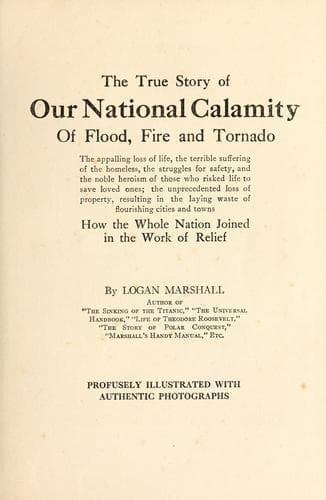
The True Story of Our National Calamity of Flood, Fire and TornadoMarshall, Logan
History
The True Story of Our National Calamity of Flood, Fire and Tornado
Marshall, Logan
Floods -- Ohio River Valley; Omaha (Neb.) -- Tornado, 1913
"According to my advices, the situation beggars description," said Mr.
Brandon. "What the people need most of all is boats. The water is high
in every street and assistance late this afternoon was simply out of the
question. My superintendent at Dayton told me that at least sixty had
perished and probably a great many more, at the same time assuring me
that unless something that closely approached a miracle happened the
death list would run considerably higher. We are now rigging up several
special trains and will make every effort possible to get into Dayton
tonight."
It was on these scenes of indescribable horror that the shades of night
closed down.
CHAPTER III
DAYTON'S MENACE OF FIRE AND FAMINE
FIRE BREAKS OUT--HUNDREDS IMPERILED BY FLAMES--THE CITY
THREATENED--70,000 IMPRISONED BY THE WATER--"SEND US
FOOD!"--PATTERSON CONTINUES RESCUE WORK--PHONE OPERATOR BELL A
HERO--EXPERIENCES OF THE SUFFERERS--INSTANCES OF
SELF-SACRIFICE--LOOTERS AT WORK.
Scarcely had the appalling horror of the flood impressed itself on the
stricken people of Dayton before a new danger arose to strike terror to
their hearts--fire that could not be fought because there was no way to
reach it and because the usual means for fire-fighting were paralyzed.
FIRE BREAKS OUT
One fire started from the explosion of an oil tank containing hundreds
of gallons which bumped into a submerged building.
The fire started in a row of buildings on Third Street near Jefferson,
right in the heart of the business section, and not far from the
Algonquin Hotel, the Y. M. C. A., and other large buildings.
The report of the fire was sent out by Wire Chief Green, of the Bell
Telephone Company, who said the fire was then within a block of the
telephone exchange in which was located John A. Bell, who for more than
twenty-four hours had kept the outside world informed as best he could
of the catastrophe in Dayton.
A. J. Seattle, owner of the house in which the fire started after a gas
explosion, was blown into the air and killed instantly.
Mrs. Shunk, a neighbor, was blown out of her home into the flood. After
clinging to a telegraph pole for half an hour, she finally succumbed and
was sucked under the waters.
The explosion blew a stable filled with hay into the middle of the
flooded street and this carried the flames to the opposite side.
The next house to burn was Harry Lindsay's. Then Mary Kreidler's and
then the home of Theodore C. Lindsay and other houses that had been
carried away from their foundations floated into the flames and soon
were on fire.
The floating fires burned without restraint and communicated flames to
many other buildings where families awaited help.
Public-domain text, read in full here on John Shaqi.
Reviews
Reviews
No reviews yet
Be the first to share your thoughts on this work.
Join the Discussion
Join the discussion
Sign in to leave a comment or review.
Sign InorCreate an account