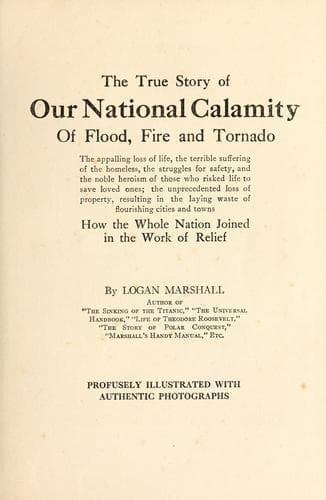
The True Story of Our National Calamity of Flood, Fire and TornadoMarshall, Logan
History
The True Story of Our National Calamity of Flood, Fire and Tornado
Marshall, Logan
Floods -- Ohio River Valley; Omaha (Neb.) -- Tornado, 1913
The Beckel House was threatened and Jefferson Street was on fire on its
east side from Third Street as far down as the Western Union office.
Refugees driven from their places where they had sought safety from the
floods were leaping from roof to roof to escape the new terror. The fire
was rapidly approaching the Home Telephone plant.
HUNDREDS IMPERILED BY FLAMES
Another fire which started from an explosion in the Meyers Ice Cream
Company place, near Wyoming Street, spread and burned the block on South
Park, a block from Wyoming.
Flames, starting at Vine and Main Streets, jumped Main Street and the
houses on the other side were soon aflame. In the middle of the street
were a few frame houses that had been washed from their foundations.
These were swirled about for a time, and, as though to aid in the
passing of the section by fire, they were cast into the path of the
flames. Persons hurried from their roof tops, where they had been driven
by the flood, to the roof tops of adjoining houses.
A fire that appeared to threaten the entire business section was
confined to the block bounded by Second and Third Streets and Jefferson
and St. Clair Streets. In the block were the Fourth National Bank,
Lattiman Drug Company, Evans' Wholesale Drug Company and several
commission houses. This fire subsided somewhat by evening.
Fire broke out in the buildings on Broad Street and many who had taken
refuge in the upper floors were threatened with death in the smoke and
flames.
Sixteen persons were housed in the Home Telephone Building with a block
and tackle rigged as a means of egress if the fire pressed them.
GOVERNOR COX AIDS
It was reported to Governor Cox that some had leaped from the buildings
into the flood. The Governor received word via Springfield that 10,000
to 12,000 persons were in the burning buildings, fighting the fire by
water lifted in buckets from the flood.
Governor Cox asked the Associated Press to notify its West Virginia
correspondents to get in touch with natural gas companies supplying
Dayton with gas and ask them to shut off the supply of gas in Dayton, as
the gas was feeding the conflagration there.
Pleading that troops be sent to Dayton to relieve the flood sufferers,
saying that their need was imperative, and that the town was at the
mercy of looters and fires, George B. Smith, president of the chamber of
commerce of Dayton, who escaped from the flooded city, wired Governor
Cox from Arcanum.
Governor Cox, following the information that Dayton was on fire and that
those who had sought refuge in the upper stories of buildings were in
danger, determined at six o'clock to reach Dayton with troops and
assistance.
THE CITY THREATENED
It was impossible to get within two miles of the fire, and from that
distance it appeared that explosions, probably of drugs, made the fire
seem of larger proportions than it was. It appeared to have about burned
itself out, and it was not believed it would spread to other blocks.
Public-domain text, read in full here on John Shaqi.
Reviews
Reviews
No reviews yet
Be the first to share your thoughts on this work.
Join the Discussion
Join the discussion
Sign in to leave a comment or review.
Sign InorCreate an account