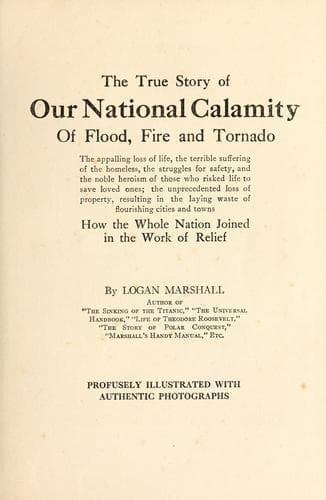
The True Story of Our National Calamity of Flood, Fire and TornadoMarshall, Logan
History
The True Story of Our National Calamity of Flood, Fire and Tornado
Marshall, Logan
Floods -- Ohio River Valley; Omaha (Neb.) -- Tornado, 1913
By ten-thirty the water depth had lessened about two feet. All stores
and factories in the main part of the town were flooded to a depth of
from eight to ten feet. Numerous residences and smaller buildings
collapsed, but any estimate of the property loss was impossible.
A morgue was established on the west side of the city, and efforts to
recover the bodies and aid the suffering were pushed as rapidly as
conditions permitted. Relief trains began to arrive in the stricken
towns.
Adjutant-General Speaks, with a small detachment of troops and a squad
of linemen and operators, left Columbus early Wednesday in an effort to
reach Dayton. The attempt was made by means of motor boats and
automobiles in the hope to establish adequate telegraph or telephone
communication with Dayton.
MARTIAL LAW ESTABLISHED
A message from Governor Cox ordered the entire Ohio National Guard to
hold itself in readiness to proceed to Dayton as soon as it was possible
to enter the city.
"I understand the importance of having the militia there," he
telegraphed.
Soon afterward notice was posted in headquarters of the emergency
committee announcing that the city was under martial law, and several
companies of soldiers arrived from neighboring Ohio cities.
The soldiers were employed to patrol edges of the burned district, and
prevent looting of homes freed from the floods.
The hundreds of refugees in the Y. M. C. A. building and in the
Algonquin Hotel were facing possible short rations. Their food supplies
were becoming limited and drinking water was at a premium.
Forty boats were requisitioned by the city authorities and were
patroling the city in an effort to save life and property. These craft
were manned by volunteers.
In front of the Central Union Telegraph office the water was still
running so swiftly that horses could not go through it without swimming.
One boat went by with two men in it, rowing desperately, trying to keep
the bow to the waves. The boat overturned, but both men escaped drowning
by swimming to a lamp post. They clung to the post for half an hour
before a rope could be thrown to them. After repeated casts the line
fell near enough to them to be caught, and the men were drawn into the
second story window of the building.
The telephone employees in the building fished chairs, dry goods boxes
and a quantity of other floating property from the flood. The debris
swept down the main business street with such force that every plate
glass window was smashed.
Only one sizable building had collapsed up to noon so far as the
watchers in the telephone office could learn. This structure, an old
one, was a three-story affair, near Ludlow Street, occupied by a harness
manufacturing concern.
70,000 IMPRISONED BY THE WATER
More than 70,000 persons either were unable to reach their homes or,
held in their waterlocked houses, were unable to reach land.
Public-domain text, read in full here on John Shaqi.
Reviews
Reviews
No reviews yet
Be the first to share your thoughts on this work.
Join the Discussion
Join the discussion
Sign in to leave a comment or review.
Sign InorCreate an account