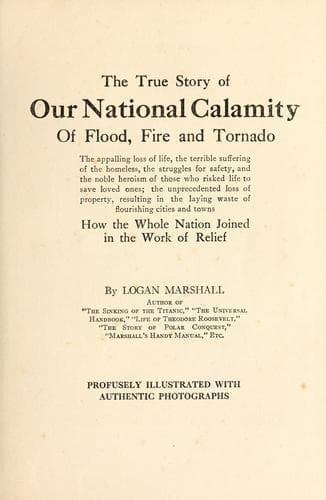
The True Story of Our National Calamity of Flood, Fire and TornadoMarshall, Logan
History
The True Story of Our National Calamity of Flood, Fire and Tornado
Marshall, Logan
Floods -- Ohio River Valley; Omaha (Neb.) -- Tornado, 1913
It was impossible to ascertain, even approximately, the number of
persons who might have been marooned in this section and who died after
being trapped by flood and fire.
The flames at night cast a red weird glow over the flood-stricken city
that added to the fears of thousands of refugees and marooned persons,
and led to apprehension that there might have been many of the water's
prisoners in the burned buildings.
Fire started anew at nine o'clock at night and burned fiercely.
The men, women and children marooned in the Beckel Hotel were terror
stricken when fire threatened the building for the second time at night.
Since Tuesday morning two hundred and fifty persons had been in the
place.
Crowded in the upper stories of tall office buildings and residences in
Dayton, two miles each way from the center of the town, were hundreds of
persons whom it was impossible to approach. Hundreds of fires which it
was impossible to fight were burning. The rescue boats were unable to
get farther from the shore than the throw line would permit. They could
not live in the current.
At midnight residents of Dayton watching the course of the flames from
across the wide stretch of flood waters believed the fire got its new
start in the afternoon in the store of the Patterson Tool and Supply
Company, on Third Street, just east of Jefferson, whence it ate its way
west, apparently aided by escaping gas and exploding chemicals in two
wholesale drug establishments.
Throughout the night fires lighted the sky and illuminated the rushing
waters. Fifty thousand people were jammed in the upper floors of their
homes, with no gas, no drinking water, no light, no heat, no food.
[Illustration: Copyright by Underwood & Underwood, N. Y.
The flood at Watervliet, New York, showing buildings torn from their
foundations and floating down the stream. Great damage and untold
suffering resulted]
[Illustration: Copyright by Underwood & Underwood, N. Y.
Rescuer leaving one of the houses in the flooded district and removing a
family to safety]
THE CREST OF THE FLOOD
The crest of the Dayton flood passed about midnight, but the next few
hours allowed no appreciable lowering in the water. Wednesday morning
brought little hope of immediate relief to those who spent the night in
horror, however, and it was feared that the number of drowned had been
greatly increased during the twelve hours of darkness.
Cloudy skies and a cold drizzling rain added to the dismal aspect of the
city in the morning. The temperature fell steadily all night, and when
daylight came the thermometers showed that it was only three degrees
above freezing. The condition was welcomed, because it was expected that
a hard freeze would aid materially in holding back the innumerable
tributaries of the flooded streams and assist the earth in retaining the
moisture that had been soaked into it steadily for the last five days.
Public-domain text, read in full here on John Shaqi.
Reviews
Reviews
No reviews yet
Be the first to share your thoughts on this work.
Join the Discussion
Join the discussion
Sign in to leave a comment or review.
Sign InorCreate an account