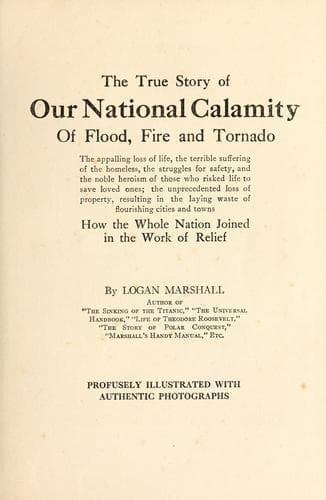
The True Story of Our National Calamity of Flood, Fire and TornadoMarshall, Logan
History
The True Story of Our National Calamity of Flood, Fire and Tornado
Marshall, Logan
Floods -- Ohio River Valley; Omaha (Neb.) -- Tornado, 1913
The first trainload of provisions from Cincinnati, with a detail of
policemen to help in the rescue work, reached Dayton after being twelve
hours on the road. This, with two cars from Springfield, relieved the
immediate suffering. Word also was received that a carload of supplies
was on the way from Detroit.
Encouragement was received in a message from the Mayor of Springfield,
who said he was sending six big trucks loaded with provisions that
should reach Dayton early Thursday. With the arrival of motor boats
Wednesday night it was hoped to begin to distribute provisions among the
marooned early next morning.
Messages from the flood's prisoners in the business section said
children were crying for milk, while their elders suffered from thirst
that grew hourly. Volunteers were called for to man boats and brave the
dangerous currents in an attempt to get food to the suffering.
PATTERSON CONTINUES RESCUE WORK
Rescue work efficiently managed, in which John H. Patterson was a
leading spirit, proceeded smoothly throughout the day. A boat, which was
engaged in rescue work, capsized, and all of the crew but Frederick
Patterson, son of John H. Patterson, were drowned. Young Patterson acted
as captain of the crew.
Missing members of families were restored to their loved ones through
human clearing houses established at several points in the fringe of the
flood district. Great ledgers filled with names presided over by
volunteer bank clerks were at the disposal of persons seeking missing
kinsmen. If these had registered in the clearing house their addresses
were quickly given to the inquirer.
Up to seven o'clock in the evening three thousand of the homeless were
housed in different places of refuge, most of them being cared for at
the plant of the National Cash Register Company. Scores of the waters'
victims were being carried from their places of imprisonment late in the
evening, and leaders of the rescuing parties were arranging for relays
of torch bearers to light the work during the night.
The powerful current on each cross street made it impossible for those
manning the rowboats to pass a street crossing without the aid of tow
ropes. Lines were stretched in many places and trolley boat paths
brought many victims out. Every automobile in the city was pressed into
service and used to meet paths and take the refugees at once to the
hospitals.
"Our greatest need is a dozen motor boats and men to run them," was the
message contained in an appeal sent out by Mr. Patterson. Skiffs and
rowboats could not live in torrents rushing through the city's principal
streets.
The big plant of the National Cash Register Company was made relief
headquarters. As persons were rescued they were taken to a relief
sub-station, where their names were recorded and they received first
aid. At frequent intervals these lists were sent to relief headquarters
and announced to crowds who waited in the rain for hours.
Public-domain text, read in full here on John Shaqi.
Reviews
Reviews
No reviews yet
Be the first to share your thoughts on this work.
Join the Discussion
Join the discussion
Sign in to leave a comment or review.
Sign InorCreate an account