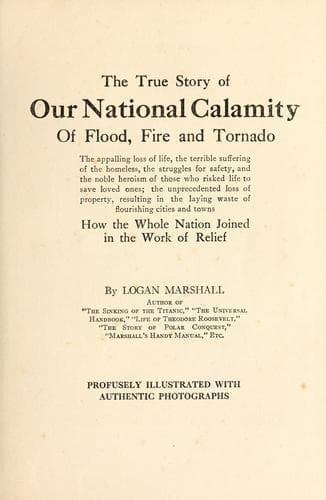
The True Story of Our National Calamity of Flood, Fire and Tornado — John Shaqi
The True Story of Our National Calamity of Flood, Fire and TornadoMarshall, Logan
History
The True Story of Our National Calamity of Flood, Fire and Tornado
Marshall, Logan
Floods -- Ohio River Valley; Omaha (Neb.) -- Tornado, 1913
Two expert oarsmen, Fred Patterson and Nelson Talbott, conquered the
current for a short distance on Main Street late in the afternoon.
"We penetrated to almost the center of the city," said Mr. Patterson.
"Everywhere people yelled to us to rescue them, but it was impossible,
for we were barely able to keep afloat. Large sums of money were offered
us to take persons from perilous positions. The windows of the Algonquin
Hotel seemed filled with faces, and the same conditions prevailed at
most of the buildings we passed. We did not see any bodies, but the loss
of life must have been great."
At Xenia a relief committee was organized to send supplies to Dayton.
All the churches were made ready for Dayton refugees.
PHONE OPERATOR BELL A HERO
Two employees of the American Telephone and Telegraph Company, John A.
Bell, wire chief at Dayton, and C. D. Williamson, wire chief at
Phoneton, Ohio, by unprecedented devotion to duty kept Dayton in touch
with the world.
At midnight they had been on duty continuously for forty-eight hours,
and, although there was no prospect of their being relieved, they gave
not the slightest indication of any inclination to leave their posts.
Bell reached the Dayton office before the flood broke on Tuesday
morning. The water came with such suddenness that all batteries and
power were out of commission before any measure could be taken to
protect them. This left the wires without current and effectually cut
off Dayton. Bell rummaged around and found a lineman's "test set." With
this he made his way to the roof of the building, "cut in" on the line
to Phoneton and reported to Williamson, whose batteries were still in
condition. Over this meagre equipment messages were exchanged by means
of the underground wires of the company, which held up until after the
noon hour Tuesday before the cable in which they were incased gave way.
The break, however, was south of Dayton, and Phoneton was still in touch
with the flood-stricken city.
Except for brief intervals, Bell remained on the roof of the building
suffering the discomforts of pouring rain and low temperature, in order
that the waiting world might have some word from Dayton.
EXPERIENCES OF THE SUFFERERS
Late in the afternoon several refugees told stories that gave an insight
into conditions in East Dayton, hitherto unexplored. The flood victims
declared they knew of no loss of life in this section, because a great
number of people had availed themselves of warnings and fled.
A Mrs. Van Denberg, who remained until the flood enveloped her home,
when rescued declared she had seen no bodies in the flood.
Sixty-five persons were marooned in the central police station. Nothing
had been heard from Mayor Phillips, of Dayton, or from Brigadier-General
Wood, marooned, it was believed, in North Dayton.
Public-domain text, read in full here on John Shaqi.
Reviews
Reviews
No reviews yet
Be the first to share your thoughts on this work.
Join the Discussion
Join the discussion
Sign in to leave a comment or review.
Sign InorCreate an account