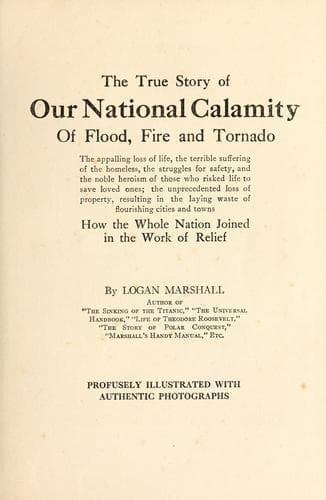
The True Story of Our National Calamity of Flood, Fire and Tornado — John Shaqi
The True Story of Our National Calamity of Flood, Fire and TornadoMarshall, Logan
History
The True Story of Our National Calamity of Flood, Fire and Tornado
Marshall, Logan
Floods -- Ohio River Valley; Omaha (Neb.) -- Tornado, 1913
The whole story of the Dayton disaster probably never will be told--the
heroism of men; the martyrdom of women; the mad hysteria that seized
some and caused them to jump into the flood and death; the torture of
despair that gripped those who, imprisoned in their homes by the water,
waited in vain for help until the advancing flames came and destroyed
them. The most heartrending feature of the situation was the pitiable
terror of the women and children. Many of them sat up and sobbed through
the night refusing to believe that their fathers had been drowned in the
satanic waters.
Mrs. James Cassidy and her three children were brought from the flood
last night. Mrs. Cassidy was grief-stricken over the report of the death
of her husband by drowning. Even as she was being registered there was
brought into rescue headquarters a drenched man who had to be carried.
"Jim! Jim!" suddenly shrieked the woman. "That's you, Jim, isn't it? You
aren't dead, Jim. Say you aren't dead."
Jim had been rescued from drowning. The return of James Cassidy was the
one bit of joy in the awful gloom at the rescue headquarters, where
gathered the victims of flood, fire and famine.
CRAZED BY HER EXPERIENCE
A woman, maddened by the horrors of the day, fought with Bill Riley and
his companion, Charles Wagner, who had rescued her in a boat.
She bit Riley in the hand and choked Wagner, who sought to restrain her.
The little boat swayed and was on the point of capsizing when the woman
suddenly became calm and began to pray.
A big sturdy man cried like a child in the offices of the National Cash
Register Company. He had been to the hospitals, the schools where
refugees are housed and to the churches--but in none of these was his
family.
In many similar cases relatives of the supposed dead were uncertain as
to the fate of the missing. The money loss was heavy, but nobody cared
about money loss, though it ran into the millions.
In this hour of Dayton's woe money apparently was the most useless thing
in the world.
A graphic story was told by Edsy Vincent, a member of the Dayton fire
department. His engine house was within a few doors of Taylor Street,
where the break of the levee occurred.
The department watchers, fearing being flood-bound, sounded the fire
call simultaneously with the break in the levee.
"When the horses, which were hitched in record time, reached the
street," said Vincent, "we were met by a wall of water which must have
been ten feet high. The driver was forced to turn and flee in the
opposite direction to save the team and the apparatus."
INSTANCES OF SELF-SACRIFICE
The dark colors in these incidents were lightened here and there by
stories of bravery exhibited by many of the flood prisoners.
A woman with three children marooned in the upper floor of her home on
the edge of the business district called to the oarsmen:
Public-domain text, read in full here on John Shaqi.
Reviews
Reviews
No reviews yet
Be the first to share your thoughts on this work.
Join the Discussion
Join the discussion
Sign in to leave a comment or review.
Sign InorCreate an account