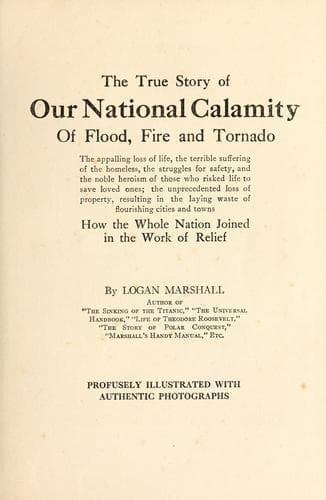
The True Story of Our National Calamity of Flood, Fire and TornadoMarshall, Logan
History
The True Story of Our National Calamity of Flood, Fire and Tornado
Marshall, Logan
Floods -- Ohio River Valley; Omaha (Neb.) -- Tornado, 1913
Over in North Dayton, when the lowlands were inundated by the rush of
the waters of the Mad River, the foreign population, which practically
occupies that section, was driven to the upper floors and the housetops.
With the extinguishing of the city's lights bedlam broke loose in
various portions of North Dayton. Men in the frenzy of their trouble
fell to desperate quarreling among themselves, and shots were heard at
all hours of the day and night Wednesday and Thursday.
There were unconfirmed reports that more than a dozen murders had been
committed. Troops were ordered into this district to stop the conflicts.
RESTORING SANITATION
Problems of sanitation, the water supply and the reconstruction of the
wrecked sewer system were resumed by engineers. Citizens were ordered to
dig cesspools in their yards and to get rid of all garbage. Members of
the State Board of Health, bringing carloads of lime and other
disinfectants, reached here to ward off disease.
A report was circulated that an epidemic of typhoid fever and pneumonia
had developed in Riverdale and West Dayton. It was ascertained, however,
that not a single well-developed case of either disease was known in the
sections mentioned, although there was considerable sickness among the
refugees, particularly women and children, due to privation.
Three deaths from diphtheria in other sections were reported by
Secretary of Health Board Miller.
FEEDING THE HOMELESS
The food situation was much brighter. The trucks sent from the Cash
Register Company, manned by men with military orders to confiscate
potatoes and food from the farmers, brought back a good supply of
vegetables and several relief trains reached the city.
The problem of providing for refugees was bravely faced by an army of
workers, many of whom came from neighboring cities equipped with car
loads and train loads of food.
"We can't tell how much we need," said John M. Patterson "and we don't
know yet in just what shape we want some of the supplies. For instance,
there came a carload of flour. We can use it later, but if that flour
had been made into bread it would have been immediately available for
the persons imprisoned in their homes whom it has been impossible to
remove. We could take bread to them, but flour is not serviceable."
Many motor boats went into the flooded district taking food and water
and bringing out persons who needed medical attention. Many of them were
so weak from deprivation and suffering as to be scarcely able to move.
Hundreds were taken to the Cash Register Hospital and other places where
they could be aided.
Among those taken out of the Algonquin Hotel were Stephen Patterson and
his wife. Mr. Patterson is a brother of John H. Patterson, the cash
register manufacturer. Great anxiety had been felt for their safety and
also for Mrs. Frank Patterson, a sister-in-law. The latter was found in
her home on West Fifth Street.
HUNDREDS STAND BY HOMES
Public-domain text, read in full here on John Shaqi.
Reviews
Reviews
No reviews yet
Be the first to share your thoughts on this work.
Join the Discussion
Join the discussion
Sign in to leave a comment or review.
Sign InorCreate an account