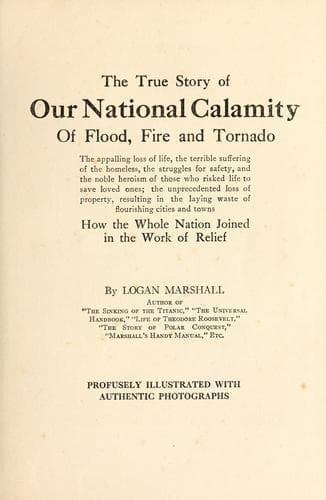
The True Story of Our National Calamity of Flood, Fire and TornadoMarshall, Logan
History
The True Story of Our National Calamity of Flood, Fire and Tornado
Marshall, Logan
Floods -- Ohio River Valley; Omaha (Neb.) -- Tornado, 1913
In that section on the east side of the Miami River and north of the Mad
River rescue work went forward with the two United States life-saving
crews in charge. Hundreds of people living in upper stories and
practically without food or water since Tuesday morning refused to leave
their homes, believing they would have a better chance for safety there
than elsewhere. Water and food were supplied them. Hundreds of others
had left their homes, in some instances effecting exits by chopping
holes through the roofs. Very few of these were accounted for.
[Illustration: Copyright by Underwood & Underwood, N. Y.
While the flood was raging, hundreds of fires which started throughout
the flooded States were left to consume millions of dollars worth of
property, and to destroy many lives, because of the inability of the
fire-fighters to get near the burning buildings]
[Illustration: Copyright by Underwood & Underwood, N. Y.
President John H. Patterson, of the National Cash Register Company,
third man from the right, directing the work of rescue at Dayton, Ohio.
Through his magnificent skill as an organizer, and his coolness of mind,
scores of lives were saved that would otherwise have been lost, and a
great deal of suffering was alleviated by his prompt measures of relief]
A central morgue was established at the Probate Court building, and as
fast as possible identifications were made. Many of the bodies thus far
recovered, however, presented difficulties in the way of identification.
Colonel Zimmerman reported that boatloads of provisions continuously
were going into the still inundated districts. Milk for babies and
medicine for invalids were not forgotten by the rescue squads. Governor
Cox solved the problem of getting milk for Dayton's babies by
confiscating in the name of the State the entire output of the
Marysville dairies, and having it sent to the stricken city. The state
also seized two cars of eggs at Springfield found in a railroad yard and
sent them to Dayton.
PATTERSON CONTINUES NOBLE WORK
The dead bodies were placed in coffins as soon as they were identified.
These coffins and decent burial for the victims were paid for by the
President of the National Cash Register Company, who footed most of the
bills in the tremendous and efficient work of relief.
The weather was bitter cold, but the rain ceased to fall. Thousands of
survivors who spent two nights marooned in buildings without light, heat
or food on Friday night slept in warm beds.
CHAPTER V
THE RECUPERATION OF DAYTON
SPIRITS GO UP--SECRETARY OF WAR GARRISON ON THE SCENE--CLEARING
AWAY THE DEBRIS--BOAT CREWS SAVE 979--RELIEF ON BUSINESS
BASIS--STRICT SANITARY MEASURES--TALES OF THE RESCUED--A SUMMARY OF
WORK ACCOMPLISHED--RAILROADS AGAIN WORKING--COMMISSION GOVERNMENT
ESTABLISHED--A HOME OF TENTS--MILLIONAIRES IN THE
BREAD-LINE--ORVILLE WRIGHT'S ESCAPE--DEATH AND PROPERTY LOSS--THE
TASK OF REBUILDING.
Public-domain text, read in full here on John Shaqi.
Reviews
Reviews
No reviews yet
Be the first to share your thoughts on this work.
Join the Discussion
Join the discussion
Sign in to leave a comment or review.
Sign InorCreate an account